
Honda CR-V vs Nissan Rogue: Which One Is Better?
So, you’ve decided to drive a compact SUV, but you’re still not sure which one to take home.
Should it be the Honda CR-V, known for its reliability, or the Nissan Rogue, which is said to offer better value for money?
In this comparison, I’ll take a comprehensive look at the CR-V and the Rogue. By the end of the article, I’m confident you’ll have a clear idea of which SUV you’ll be driving home.
Disclaimer: All specifications, prices, and features in this article refer to the 2026 model year for both the Honda CR-V and the Nissan Rogue.
Key Differences at a Glance
Both are in the same pool, targeting the same consumers. However, they still have some different priorities.
Here are some key differences between the Honda CR-V and the Nissan Rogue.
| Feature | 2026 Honda CR-V | 2026 Nissan Rogue |
|---|---|---|
| Starting Price (FWD) | $30,920 (LX) | $29,490 (S) |
| Engine | 1.5L Turbo I4 (gas) / 2.0L Atkinson + e-motor (hybrid) | 1.5L VC-Turbo I3 |
| Horsepower | 190 hp (gas) / 204 hp (hybrid) | 201 hp |
| Torque | 179 lb-ft (gas) / 247 lb-ft (hybrid) | 225 lb-ft |
| Transmission | CVT | Xtronic CVT |
| EPA MPG (FWD, gas/base) | 28 city / 33 hwy / 30 combined | 29 city / 36 hwy / 32 combined |
| Towing Capacity | 1,500 lbs (gas) / 1,000 lbs (hybrid) | 1,500 lbs |
| Cargo (seats up / folded) | 39.3 / 76.5 cu ft (gas); 36.3 / 71.8 cu ft (hybrid) | 36.5 / 74.1 cu ft |
| Infotainment Screen | 9″ touchscreen (all trims) | 8″ (base) or 12.3″ (upper trims) |
| Wireless Apple CarPlay | Standard (all trims) | Platinum only (other trims have wired CarPlay) |
| Wireless Android Auto | Standard (all trims) | Platinum only (other trims have wired Android Auto) |
| Google Built-in | Sport Touring only | N/A |
| Wireless Phone Charging | Standard (all trims) | Available (select trims) |
| AWD Availability | Optional (+$1,500) / Standard on TrailSport & Sport Touring | Optional (+$1,400) / Standard on Rock Creek & Platinum |
Trim Levels and Pricing
Honda CR-V 2026
The CR-V lineup is split between traditional gasoline trims and the hybrid family.
Gas trims are priced attractively at entry but miss out on the impressive fuel economy of the hybrid variants.
The hybrid side covers the Sport, TrailSport, Sport-L, and range-topping Sport Touring.
| Trim | Price (FWD) | Price (AWD) |
|---|---|---|
| LX | $30,920 | $32,420 |
| EX | $33,150 | $34,650 |
| EX-L | $35,400 | $36,900 |
| Sport Hybrid | $35,630 | $37,130 |
| Sport-L Hybrid | $38,725 | $40,225 |
| TrailSport Hybrid | $38,800 | Standard AWD |
| Sport Touring Hybrid | $42,550 | Standard AWD |
Nissan Rogue 2026
The Rogue lineup includes five main trims: S, SV, Dark Armor, Rock Creek, and Platinum. With the new Dark Armor trim joining for 2026 as a sporty appearance package.
AWD is optional on S, SV, and Dark Armor; standard on Rock Creek and Platinum.
| Trim | Price (FWD) | Price (AWD) |
|---|---|---|
| S | $29,490 | $30,890 |
| SV | $30,490 | $31,890 |
| Dark Armor | $33,340 | $34,740 |
| Rock Creek | AWD Only | $34,390 |
| Platinum | AWD Only | $39,390 |
Prices exclude tax, registration, delivery charges, and dealer fees. Dealer prices may vary.
Off-Road Styled: TrailSport vs. Rock Creek
Both manufacturers have recognized the growing demand for adventure-styled compact SUVs, and each has an answer: the CR-V TrailSport Hybrid and the Rogue Rock Creek.
The CR-V TrailSport ($38,800, AWD standard) comes with all-terrain tires, unique amber LED exterior lighting accents, and the full CR-V Hybrid powertrain delivering 204 horses.
It’s quick for an off-road-styled crossover, and the all-wheel drive system provides excellent low-end torque for crawling over rough surfaces.
The Rogue Rock Creek ($34,390, AWD only) brings all-terrain tires, a specially tuned suspension for off-road use, a 360-degree HD camera, and a unique leatherette interior with Rock Creek badging.
At nearly $4,400 less than the TrailSport, it’s the more affordable path to adventure styling. However, it gives up the hybrid efficiency advantage and makes do with the standard 201 hp VC-Turbo engine.
Top Trim: Sport Touring vs. Platinum
At the pinnacle of each lineup, both brands pull out the premium features.
The CR-V Sport Touring Hybrid ($42,550) brings a 12-speaker Bose audio system, Google built-in (Maps, Assistant), hands-free power tailgate, panoramic moonroof, heated and ventilated front seats, and 19″ wheels. Plus the class-leading hybrid fuel economy of 40 MPG combined.
The Rogue Platinum ($39,390) offers available quilted semi-aniline leather, a 12.3″ touchscreen, ProPILOT Assist 2.1 semi-autonomous driving, dual-panel panoramic moonroof, LED ambient lighting, and available Bose 10-speaker audio. At roughly $3,160 less than the Sport Touring, it delivers impressive value at the top of the range.
The Sport Touring’s Google built-in integration and Bose 12-speaker system edge it ahead for tech lovers, and the hybrid powertrain adds a running-cost advantage. But the Rogue Platinum is a luxurious SUV at a lower price.
Exterior Look
Styling is ultimately a matter of personal taste, so I won’t try to crown a winner here — but it’s worth knowing what each SUV offers in terms of color choices.
The 2026 Honda CR-V comes in 8 exterior colors, including Crystal Black Pearl, Solar Silver Metallic, Canyon River Blue Metallic, and Radiant Red Metallic. The newest addition is Ash Green Metallic, which is exclusive to the TrailSport trim.
The 2026 Nissan Rogue offers a wider palette, with around 10 solid exterior colors, including Super Black, Glacier White, Gun Metallic, Deep Ocean Blue Pearl, and Scarlet Ember Tintcoat. Plus several two-tone combinations with a contrasting black roof available on upper trims like Dark Armor, SL, and Platinum.
If a broader color palette and two-tone options matter to you, the Rogue has the edge. If you prefer Honda’s more curated, classic lineup, the CR-V still covers most popular tastes.
Size and Dimensions
Both SUVs share similar footprints, making them comparably manageable in city parking and suburban garages.
Exterior Dimensions
| Measurement | CR-V | Rogue |
|---|---|---|
| Length | 184.8 in | 183.0 in |
| Width (excl. mirrors) | 73.5 in | 72.4 in |
| Height (FWD) | 66.2 in | 66.5 in |
| Wheelbase | 106.3 in | 106.3 in |
| Ground Clearance (AWD) | 8.2 in | 8.2 in |
The CR-V is a touch longer and wider, while height and wheelbase are virtually identical. Both share the same 8.2″ ground clearance on AWD models.
Interior Dimensions
| Measurement | Honda CR-V | Nissan Rogue |
|---|---|---|
| Front Legroom | 41.3 in | 41.5 in |
| Rear Legroom | 41.0 in | 38.5 in |
| Front Headroom | 40.0 in | 41.1 in |
| Rear Headroom | 38.2 in | 39.2 in |
| Front Shoulder Room | 57.9 in | 57.5 in (est.) |
| Rear Shoulder Room | 55.9 in | 56.5 in (est.) |
| Passenger Volume | 106.0 cu ft (gas) | 105.4 cu ft |
The CR-V offers a class-leading 41.0 inches of rear legroom, significantly more than the Rogue’s 38.5 inches. If you frequently carry tall adults in the back seat, this difference is immediately noticeable.
The Rogue counters with slightly more front and rear headroom, making it feel more open for taller drivers.
Cargo Capacity
| Configuration | Honda CR-V (Gas) | Honda CR-V (Hybrid) | Nissan Rogue |
|---|---|---|---|
| Behind Rear Seats | 39.3 cu ft | 36.3 cu ft | 36.5 cu ft |
| Max (Seats Folded) | 76.5 cu ft | 71.8 cu ft | 74.1 cu ft |
The gasoline CR-V leads in outright cargo volume with 39.3 cubic feet behind the rear seats and 76.5 cubic feet maximum — one of the best numbers in the segment.
The CR-V Hybrid and the Rogue are very close in cargo capacity. The Rogue adds a clever Divide-N-Hide cargo system that lets you configure the cargo floor in six different ways, which is a unique practical advantage for organizing gear.
Performance & Fuel Economy
Honda CR-V
The gas CR-V uses a 1.5-liter turbocharged four-cylinder, it produce 190 horsepower and 179 lb-ft of torque, paired with a CVT. It’s smooth and adequately quick for everyday driving, though it’s not a performance machine.
The hybrid lineup powered by 2.0-liter Atkinson-cycle four-cylinder pairs with two electric motors for a combined 204 hp and a substantial 247 lb-ft of torque, more than either the gas CR-V or the Rogue. The result is snappy acceleration from a stop, which makes the hybrid feel the “quickest” of the three powertrain options in real-world driving.
Fuel economy figures (EPA estimates):
- Gas FWD: 28/33/30 MPG
- Gas AWD: 28/32/30 MPG
- Hybrid FWD: 43/36/40 MPG
- Hybrid AWD (Sport/Sport-L/Sport Touring): 40/34/37 MPG
- Hybrid AWD (TrailSport): 38/33/35 MPG
Nissan Rogue
The Rogue runs a single powertrain: a 1.5-liter VC-Turbo three-cylinder with variable compression technology, producing 201 hp and a class-competitive 225 lb-ft of torque.
The variable compression system optimizes efficiency by adjusting compression ratios on the fly, one of the more technically sophisticated engines in this segment.
Fuel economy figures (EPA estimates):
- FWD (S/SV): 29/36/32 MPG
- AWD (S/SV): 28/35/31 MPG
- Rock Creek AWD: 27/32/29 MPG
- SL/Platinum FWD: 29/36/32 MPG
- SL/Platinum AWD: 28/34/31 MPG
The elephant in the room: Nissan has announced the Rogue e-Power, a hybrid powertrain that uses the gasoline engine exclusively as a generator to charge a battery that drives electric motors. It’s a unique architecture that promises significantly better fuel economy.
However, as of the 2026 model year, e-Power has not yet been released in the US market. Buyers interested in hybrid efficiency must wait for a future model year — or choose the CR-V Hybrid now.
The Rogue does have a hybrid, Rogue Plug-in Hybrid. But it’s essentially a rebadged Mitsubishi Outlander PHEV, which is a completely different platform and powertrain. Since it’s not really the same vehicle as the standard Rogue, we’re leaving it out of this apples-to-apples comparison.
The Rogue gas engine is slightly more fuel-efficient than the CR-V’s gas engine on the highway. But if fuel economy is a priority, the CR-V Hybrid’s 40 MPG combined (AWD) is in a different league from anything the current Rogue can offer.
Audio & Connectivity
Both SUVs arrive well-equipped for the modern connected driver, but there are meaningful differences between trim levels.
Honda CR-V
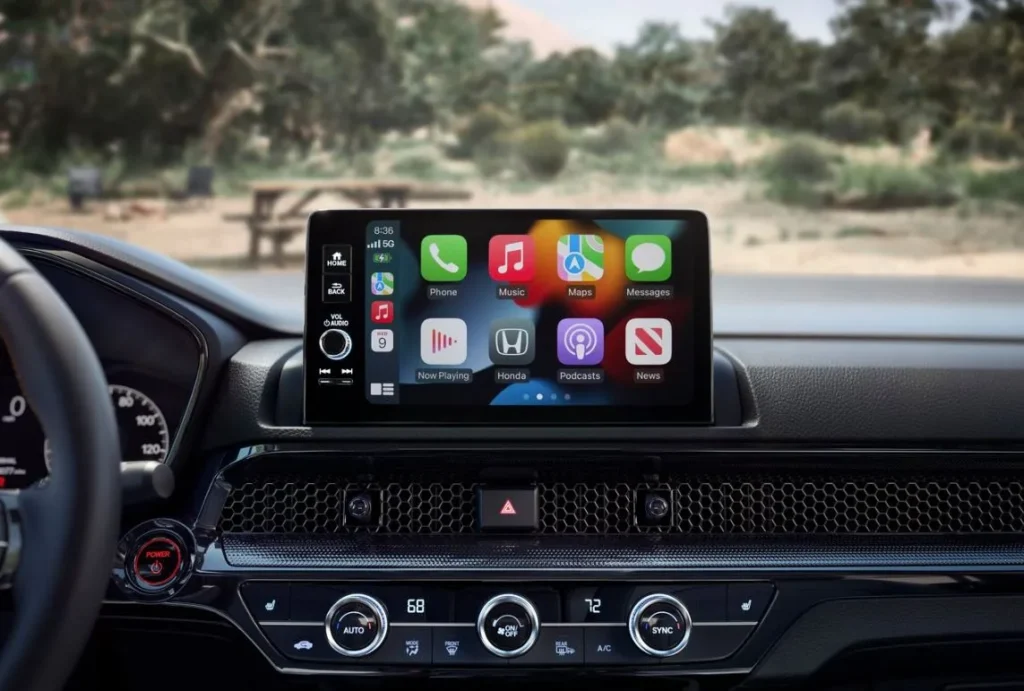
Honda become super generous with A 9-inch touchscreen is standard across every trim, even the base LX.
Wireless Apple CarPlay and wireless Android Auto are also standard on all trims, as is wireless Qi phone charging.
The top Sport Touring trim upgrades to a 12-speaker Bose Premium Audio system and adds Google built-in.
Nissan Rogue
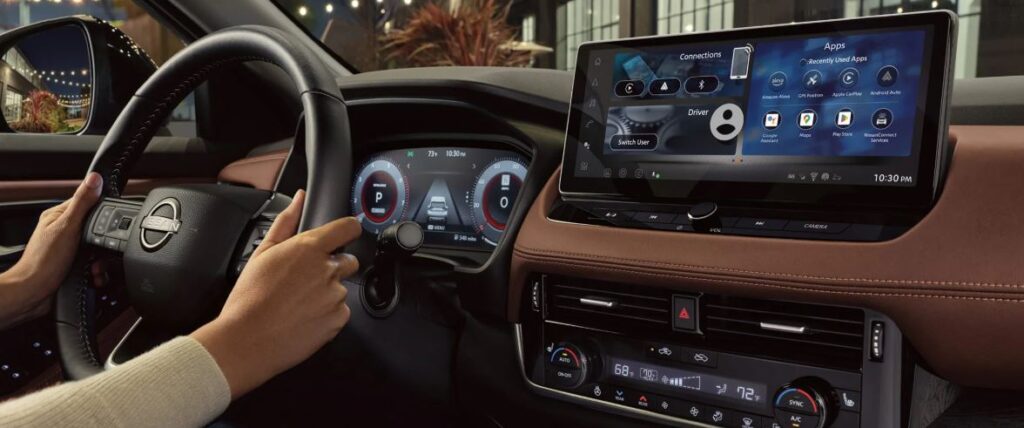
The base S trim gets an 8-inch touchscreen, which feels dated compared to the CR-V’s universal 9-inch screen.
Upgrading to the SV or above unlocks a generous 12.3-inch touchscreen, it actually larger than anything in the CR-V lineup.
Apple CarPlay and Android Auto come wired on most trims; wireless connectivity for both is reserved for the top Platinum trim only.
Wireless phone charging is available but not universal.
Upper trims offer a 10-speaker Bose Premium Audio system. Notably, the Rogue does not offer Google built-in.
Comfort & Convenience
Honda CR-V
Honda Sensing (full driver-assistance suite) is standard across all trims.
The EX and above add a power moonroof, Dual-Zone Automatic Climate Control System, heated front seats, and remote start.
The EX-L brings leather seating. The Sport Touring tops the range with heated front seats, a heated steering wheel, a panoramic moonroof, and a hands-free power tailgate.
The TrailSport features unique orange interior stitching and accent lighting.
Nissan Rogue
The Rogue’s Zero Gravity front seats are a standout feature for long-distance comfort. An available 8-way power driver’s seat with lumbar support and memory is available on higher trims.
The Rogue Platinum offers heated and available ventilated front seats, heated rear seats, LED ambient lighting, and a dual-panel panoramic moonroof.
The Rock Creek adds a motion-activated liftgate and the HD 360-degree camera system.
Safety & Driver Assistance
Both vehicles offer comprehensive standard safety suites, making them among the safest options in the compact SUV segment. Both received a 5-star NHTSA rating and offer a long list of safety features.
However, the Nissan Rogue is slightly better, it earned the Top Safety Pick designation from the IIHS, while the Honda CR-V did not.
Both are also equipped with equally advanced driver-assistance technology: the CR-V with Honda Sensing, and the Rogue with ProPILOT.
Both Honda Sensing and ProPILOT are equipped with features that support driving convenience and safety, including:
- Collision Mitigation Braking System
- Road Departure Mitigation System
- Adaptive Cruise Control
- Lane Keeping Assist System
- Forward Collision Warning
- Auto High Beam Headlights
- Vehicle Stability Assist
- Electronic Brake Distribution
- Anti-Lock Braking System
- and many more.
Real-World Driving Experience
Spec sheets only tell part of the story. How these two SUVs actually feel from behind the wheel.
The Honda CR-V’s suspension tuning strikes a well-balanced note: comfortable enough for daily commuting, but firm enough to still feel sporty and composed through corners.
Steering feedback is precise and confidence-inspiring, which is part of why the CR-V has long been considered the class benchmark for driving manners.
In the Hybrid model, cabin insulation is noticeably better, wind and road noise stay well controlled even at highway speeds.
The gas trims are good, but I found that road noise can creep into the cabin a bit more at higher speeds, particularly on coarser pavement.
On the other hand, Rogue takes a different approach, leaning into comfort over outright sportiness.
Its suspension is tuned softer than the CR-V’s, which makes it a more relaxed companion on long highway stretches, but it gives up some of that buttoned-down, sporty feel in return.
The legendary Zero Gravity seats genuinely live up to the hype here, many drivers report noticeably less fatigue on long drives, and it’s one of the Rogue’s most consistently praised features.
Steering response, however, doesn’t match the CR-V’s precision; it feels lighter and less connected to the road.
Both SUVs use a CVT, but they don’t feel the same.
Honda’s CVT is tuned with a step-shift program that mimics the gear changes of a traditional automatic, giving it a smoother, more natural feel under acceleration.
The Rogue’s Xtronic CVT pairs with the VC-Turbo three-cylinder engine, which delivers strong low-end torque and punchy, immediate response in city driving, its great for quick merges and stop-and-go traffic.
That said, the three-cylinder’s engine note can sound and feel unusual to drivers who aren’t used to it, especially under hard acceleration.
Between the two, the CR-V comes across as the more genuinely fun-to-drive SUV, with sharper handling and a more rewarding connection between driver and road.
The Rogue counters with a comfort-first ride and those standout Zero Gravity seats, making it the better pick for drivers who prioritize a relaxed, cushioned commute over driving engagement.
Warranty & Resale Value
When comparing total cost of ownership, warranty coverage and how well a vehicle holds its value over time matter just as much as the sticker price.
Warranty coverage
Honda and Nissan offer nearly identical warranty terms on these two SUVs.
Both come with a 3-year/36,000-mile basic limited warranty, a 5-year/60,000-mile powertrain warranty covering the engine and transmission, and a 5-year/unlimited-mileage corrosion warranty.
On paper, there’s no clear winner here, both manufacturers back their compact SUVs with comparable protection.
Honda also tends to include a complimentary first scheduled maintenance visit, which the Rogue typically doesn’t offer.
Depreciation and Resale Value
This is where the gap between these two widens considerably.
Historical depreciation data (from sources like iSeeCars and Kelley Blue Book) consistently shows the CR-V holding its value significantly better than the Rogue over a 5-year ownership period.
The CR-V typically depreciates somewhere in the 29-35% range after five years, while the Rogue has historically depreciated more steeply, often in the 40-49% range over the same period.
In dollar terms, that gap can translate to several thousand dollars more in resale value for the CR-V at trade-in time.
Honda’s broader reputation for long-term reliability and durability is the main driver behind this gap — used CR-V buyers are generally willing to pay a premium for that reputation, which keeps resale prices firmer.
The Rogue, while competitively priced new, tends to see sharper early depreciation, particularly in its first year off the lot.
What this means for buyers?
If you plan to keep the vehicle for the long haul, the depreciation difference matters less — you’ll get years of use regardless.
But if you tend to trade in or sell within 3-5 years, the CR-V’s stronger resale value can meaningfully offset its slightly higher purchase price, making the real-world cost of ownership closer than the MSRP numbers suggest.
(iseecars)
Equipment & Small Details
These small features matter more than buyers often expect:
| Feature | Honda CR-V | Nissan Rogue |
|---|---|---|
| Spare Tire | Compact spare (gas trims only); Hybrid trims get tire repair kit (TRK) only | AWD Only |
| Floor Mats | Available as dealer accessory | Carpeted floor mats available |
| Roof Rails | Available on EX and above | Standard on Rock Creek; available elsewhere |
| Running Boards | Available accessory | Available accessory |
| Hands-Free Liftgate | Standard on Sport Touring | Available on Dark Armor and above |
| Motion-Activated Liftgate | N/A | Available on Rock Creek and above |
| Heated Steering Wheel | EX-L and above | SV and above |
| Remote Start | EX and above | SV and above |
| Rear Seat Recline | Not available | Yes, standard |
The compact spare tire on gas CR-V trims is a practical win — a flat tire at night is much less stressful with a real spare than with a can of sealant.
The All-wheel drive Rogue comes with a compact spare tire. This is much better than just the TRK.
Note that the CR-V Hybrid trims only come with a tire repair kit (TRK), not a spare, so this advantage doesn’t extend to the hybrid lineup.
Frequently Asked Questions
Verdict: Which Should You Buy?
Choosing between these two comes down to a clear fork in the road, because their core personalities couldn’t be more different.
Go with the Nissan Rogue if you want the absolute most tech and cabin luxury for your dollar. Nissan gives you a sharper multimedia experience, an upscale interior layout, and a snappy VC-Turbo engine that feels punchier for the daily city commute. It is the textbook definition of a high-value tech play.
However, if you’re looking for the smartest long-term buy, the Honda CR-V takes the crown.
The CR-V is the mature, drama-free choice. For 2026, Honda finally closed its biggest gap by making the larger 9-inch screen and wireless smartphone tech standard across the line.
When you look past the initial tech flash, the CR-V wins on the fundamentals: it has a more spacious back seat, a larger cargo hold, a time-tested 4-cylinder engine, and the ironclad resale value Honda is famous for.
The Rogue is the flashier gadget, but the CR-V is the better vehicle to live with for the next ten years.
One final note worth mentioning: when comparing these vehicles, make sure you’re looking at the same model year. The 2026 CR-V received meaningful updates including its standard 9″ touchscreen, wireless charging on all trims, and revised hybrid lineup. If you’re considering a 2025 model year instead, the story changes — the 2025 Rogue was well-equipped even then, while the 2025 CR-V was notably less feature-rich than the 2026. See what changed between the 2025 and 2026 Honda CR-V.
If you have any further questions, or would like to share your story about your search for an SUV, feel free to leave a comment below!