
2026 Honda CR-V vs HR-V: Family Utility or City Luxury?
So, you’ve decided to go with a Honda for your new SUV. With that choice, you know you’ll get reliability, top-tier safety features, and a car that will hold its value for years to come.
But when you visit the dealership or build a configuration online on Honda’s website, you come across a price point that’s truly confusing: $30,000!
For around thirty grand, you can take home the HR-V EX-L, the top-tier Honda HR-V that comes with a super long list of features.
On the other hand, that same $30,000 is the entry point for the Honda CR-V LX. This is the base model in its lineup, offering only essential features. But it’s still a CR-V with a roomier cabin, a more powerful engine, and legroom the Honda HR-V simply can’t match.
Is it better to have a small car that treats you like a king, or a larger car that gives your family room to breathe?
In this guide, I’ll break down dimensions, engine performance, cargo capacity, and more to help you determine which one is the best fit for your driveway.
At a Glance: Which One Should You Choose?
If you’re stuck at the $30,000 mark, here is the “Quick Verdict” based on my experience.
The Honda HR-V is perfect for those who prioritize luxury over space. You’ll get heated leather seats, a premium sound system, and a sunroof. It’s ideal for singles or couples with one child living in the city, since it’s agile and easy to park.
The Honda CR-V LX is the choice if you prioritize capability and comfort. Whether you’re a growing family, a dog owner, or someone who frequently goes on road trips, you’ll get a smoother ride, a much more powerful turbo engine, and massive cargo space that can handle your Costco shopping sprees during sales.
Take a look at the quick comparison below to get an overview.
| Feature | HR-V EX-L (Loaded) | CR-V LX (Base) |
|---|---|---|
| Price (MSRP)* | $30,350 | $30,920 |
| Interior Vibe | Premium & Tech-Heavy | Functional & Spacious |
| Best For | City Commuting / Singles | Road Trips / Small Families |
| Key Advantage | Leather trim upholstery, Heated Seats & Blind Spot Monitoring | Turbocharged Power & More Legroom |
| The Trade-off | Slightly underpowered on highways, Smaller cargo space | Basic plastic trims & manual seats |
*2026 Model Year
Dimensions & Size: City-Friendly vs. Road-Trip Ready
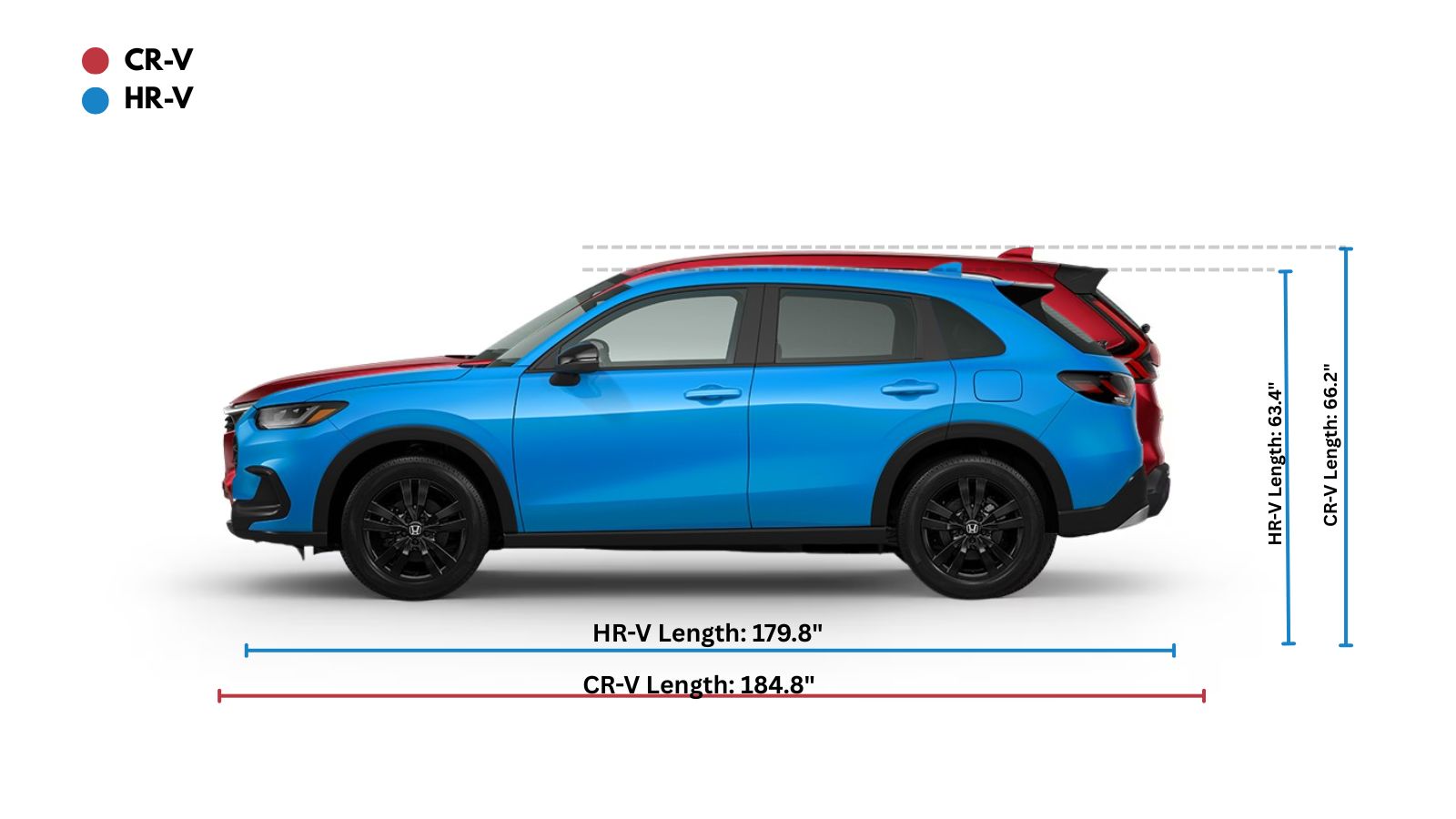
Many people are still unsure which of these two Honda SUV models is bigger, the HR-V or the CR-V.
Although at first glance they look quite similar, the numbers show that they are in different classes.
The following table will clarify everything.
| Measurement | 2026 Honda HR-V | 2026 Honda CR-V | The Difference |
| Wheelbase | 104.5 in | 106.3 in | + 1.8 in |
| Length | 179.8 in | 184.8 in | + 5.0 in |
| Height | 63.4 in | 66.2 in | + 2.8 in |
| Width | 72.4 in | 73.5 in | + 1.1 in |
| Ground Clearance | 7.0 in | 7.8 in | + 0.8 in |
| Curb Weight | 3,159 lbs | 3,472 lbs | + 313 lbs |
So, the Honda CR-V, specifically the sixth generation, is significantly larger than the HR-V. The Honda CR-V is 5 inches longer, 2.8 inches taller, and 1.1 inches wider than the Honda HR-V.
In addition to being larger, the Honda CR-V is also slightly heavier than the HR-V. However, despite its weight, the CR-V remains easy to drive, with comfortable and composed handling.
That said, I’ll admit that the Honda HR-V is a bit more agile—perhaps because it’s lighter and slightly smaller—making it well-suited for zipping around on busy streets.
Interior Space & Utility
Similar to the exterior, the two models show slight differences in interior dimensions. The details are shown in the table below.
| Measurement | 2026 Honda HR-V | 2026 Honda CR-V |
| Legroom (front/rear) | 41.9 in / 37.7 in | 41.3 in / 41.0 in |
| Headroom (front/rear) | 39.4 in / 38 in | 40.0 in / 38.2 in |
| Hiproom (front/rear) | 54.0 in / 47.4 in | 55.6 in / 52.6 in |
| Passenger Volume | 98.7 cubic feet | 106.0 cubic feet |
| Cargo Volume | 24.4 cubic feet | 39.3 cubic feet |
| Cargo Volume Behind Second Row | 55.1 cubic feet | 76.5 cubic feet |
From the table above, you can see that the Honda CR-V comes out ahead in several categories. For the front row, there isn’t much of a difference; legroom and headroom are quite similar in both, and the seats are equally comfortable.
Things change when it comes to overall passenger volume and cargo space.
The Honda CR-V is in a different league here, with a total cargo volume of 76.5 cubic feet compared to the HR-V’s 55.1 cubic feet. This significant difference makes sense—the CR-V is indeed in a different class. It’s no surprise that in some countries, like Thailand, the CR-V is even available with a third row of seats.
Numbers are one thing, but what about real-world experience?
For a small family with two toddlers, the HR-V still manages to accommodate most needs, including car seats.
Surprisingly, the HR-V can fit a car seat, though some people find they need to move the front seats forward slightly to create more space in the second row. As for the CR-V, there’s more than enough room for a car seat without adjusting the front seats.
I have a 3-year-old toddler myself. We usually need to bring items like milk, diapers, and toys when traveling.
With the CR-V, I don’t have to put those extras in the trunk; I can place them next to the car seat. With the HR-V, that’s harder to do—I often have to use the trunk or even the front passenger footwell.
On long road trips, the CR-V offers plenty of rear space for items without the need to pack them neatly. This small convenience makes a big difference, especially when you’re already tired.
So, is the HR-V unsuitable for families with children or car seats? Actually, you’ll be fine with the HR-V. But the CR-V offers more convenience.
It’s worth noting—and perhaps something to consider—that while the CR-V has the edge in interior dimensions, within the same price range (say, $30,000), the Honda HR-V offers interior materials that are far more premium.
For around $30,000, you’ll have to settle for the CR-V LX, which is the base model with cloth-upholstered seats and plastic trim here and there.
The Honda HR-V, on the other hand, already offers leather seats and soft-touch surfaces throughout, including the dashboard and door trim. To match the luxury the HR-V offers, you’ll need to go with at least the CR-V EX-L, which starts at $35,400.
Performance & Fuel Economy
Under the hood, both are equipped with different engines.
The Honda HR-V is powered by a 2.0-liter four-cylinder engine producing 158 horsepower.
Meanwhile, the CR-V is comes with a 1.5-liter turbo engine, producing more power—up to 190 horsepower.
The CR-V is also available in a hybrid model with a more powerful engine producing 204 horsepower. However, the hybrid model comes with a higher base price, around $35,630.
Both the gasoline and hybrid engines are reliable, but they have distinct characteristics; you can read my article comparing the CR-V hybrid with the gasoline version for more details.
The HR-V’s performance with its 158-horsepower engine isn’t exactly powerful, but it’s sufficient for navigating city streets. However, I found it a bit lacking in power when trying to pass—not slow, but it doesn’t feel “fast.”
Fortunately, (like most Hondas) the HR-V handles very well. It’s incredibly comfortable to drive on city streets. The engine sound is smooth—it’s just comfortable.
On the other hand, the Honda CR-V is also famous for having some of the best handling in its class. With its large body size and weight, the CR-V proves its class as one of the most comfortable family SUVs. But when driving both, the HR-V does feel a bit lighter.
The CR-V’s 1.5L engine is highly reliable; it doesn’t feel sluggish, it’s responsive, and very powerful—I really enjoyed it on the highway. Navigating mountain roads with steep inclines is no problem for the CR-V.
Both come with a smooth CVT transmission, and all-wheel drive is available on both.
An interesting point is their fuel economy: despite its lighter weight, the HR-V doesn’t actually have better fuel economy than the CR-V.
The Honda CR-V actually achieves better fuel economy.
- Honda HR-V: 26/32/28 (city/highway/combined)
- Honda CR-V: 28/33/30 (city/highway/combined)
The Honda CR-V with its 1.5L turbo gasoline engine offers exceptional fuel efficiency, considering the car’s size and weight. And that’s not even mentioning the CR-V Hybrid, which is certainly even more fuel-efficient.
Audio & Connectivity
As I’ve often mentioned in my other articles, the 2026 Honda CR-V is the most feature-packed CR-V ever, particularly when it comes to audio and connectivity, even in the base model.
Surprisingly, Honda has done the same with the HR-V. The latest HR-V comes equipped with an equally impressive list of standard features.
Several premium features that were once only available on the top trim level are now standard across all trim levels.
Both the HR-V and CR-V come fully equipped, including:
- Honda Sensing Driver Asisstance
- 9-inch multimedia screen
- 7-inch instrument cluster
- Wireless Apple CarPlay
- Wireless Android Auto
- Wireless Phone Charging
- Bluetooth Audio
- HondaLink
- USB-C charging port
However, when comparing vehicles in the same price range—around $30,000—you’ll get the HR-V EX-L, which is the top-of-the-line model, whereas you’ll be looking at the CR-V LX, which is the base model.
This difference in trim levels is significant: the HR-V EX-L offers a more comprehensive set of features, including:
- Leather-trimmed seats
- Heated front seats
- Dual-zone climate control
- Leather-wrapped steering wheel
- Leather-wrapped shift knob
- Power windows with auto up/down for the front passenger
- Sunroof
- Smart entry with walk-away auto lock
- Remote engine start
- 180-watt audio system with 8 speakers
- 8-way power adjustment for the driver’s seat
You can only get the features listed above on the Honda CR-V in higher trim levels.
Safety & Driver Assistance
Both models earned a five-star overall safety rating from the NHTSA, along with the IIHS Top Safety Pick award.
In addition, both are equipped with Honda Sensing, a suite of advanced active safety features from Honda.
However, As a top trim level, HR-V EX-L includes a few extra features such as Low-Speed Braking Control, Parking Sensors, Blind Spot Information System, and Cross Traffic Monitor. These features are missing from the base CR-V; you’ll need to upgrade to a higher trim level to get them.
These features are especially appreciated in urban driving—for example, parking sensors are clearly a big help when parking in front of narrow storefronts.
Cost of Ownership & Trim Levels
Here are the trim level details for both models.
Honda CR-V Trims
- LX: $30,920
- EX: $33,150
- Sport Hybrid: $35,630
- EX-L: $35,400
- TrailSport: $38,800
- Sport-L Hybrid: $38,725
- Sport Touring Hybrid: $42,550
Honda HR-V Trims
- LX: $26,600
- Sport: $28,400
- EX-L: $30,450
*Prices are current as of the publication of this article
Both the CR-V and HR-V come with the same warranties: a three-year (36,000-mile) limited warranty and a five-year (60,000-mile) powertrain warranty.
If you purchase a CR-V Hybrid, there’s an additional warranty for the high-voltage battery. For more details, check out the article “Hybrid Battery Guide & Warranty.”
As for maintenance costs, generally speaking, the two are comparable, but I’ve noticed a few small details that could potentially make a difference.
For example, the HR-V requires more engine oil, as its 2.0L engine has an oil capacity of 4.4 US qt (4.2 L), compared with the CR-V’s 1.5L turbo, which holds about 3.7 US qt (3.5 L). This means you’ll end up buying more oil for the HR-V.
Additionally, the CR-V’s “slightly” better fuel economy is also worth considering, since gas prices are rising every day, making every gallon of gas count.
However, if you plan to get insurance for your vehicle, the CR-V’s premiums might be higher than the HR-V’s due to the CR-V’s higher price, especially on higher trims.
Verdict
We’ve reached our conclusion—which one should you choose?
Choose the Honda CR-V if:
- You have a growing family
- You go on road trips often
- You have a large dog
Choose the HR-V if:
- You live in the city
- You’re single or have a small family
Let me wrap up with a brief statement: With $30,000 to spend, if you want a car that feels premium today, get the HR-V. If you want a car that fits your family’s lifestyle five years from now, get the CR-V.
If you have any further questions, or would like to share your experience buying an SUV, feel free to leave a comment below!