
2026 CR-V TrailSport vs. Sport Touring Hybrid
You’re shopping for a Honda CR-V and have narrowed your choices down to two trims: the adventurous TrailSport Hybrid and the top-of-the-line Sport Touring Hybrid.
Both are smart choices, but they’re built for very different types of drivers.
Here’s the thing: both trims sit in nearly the same price range at the top of the CR-V lineup.
They share identical engines, drivetrains, and some standard features.
Yet they feel like they were made for two completely different people.
One screams, “Let’s go camping!” while the other says, “I want a premium daily driver.”
In this guide, I’ll dive deeper into both variants, including specifications, features, and pricing, to help you determine which one is the best fit for you.
By the end of this article, you’ll know exactly which CR-V to drive home.
At a Glance: Which One Should You Choose?
The Honda CR-V TrailSport is perfect if you want an adventurous look right out of the box, love the stylish orange interior, and value a lower starting price. It’s ideal for those who enjoy weekend camping; the combination of AWD and all-terrain tires will take you deeper into your adventures.
The Honda Sport Touring is the choice for you if you spend more time driving on regular roads and want a premium daily driver packed with modern features. Bose audio, built-in Google, ventilated leather seats, a hands-free liftgate, and memory seating will make your road trips or daily commute a pleasure.
However, there’s something most people don’t tell you. You can actually get a CR-V that’s as comfortable as the Sport Touring and as rugged as the TrailSport with one simple change. I’ll explain this in more detail later in the article, so be sure to keep reading.
Quick Comparison: Key Differences at a Glance
| Feature | TrailSport Hybrid | Sport Touring Hybrid |
|---|---|---|
| Starting MSRP | $38,800 | $42,550 |
| Drivetrain | Hybrid AWD (standard) | Hybrid AWD (standard) |
| Powertrain | 2.0L 2-Motor Hybrid | 2.0L 2-Motor Hybrid |
| Horsepower | 204 hp | 204 hp |
| Torque | 247 lb-ft | 247 lb-ft |
| Fuel Economy (City/Hwy/Comb) | 38 / 33 / 35 mpg | 40 / 34 /37 mpg |
| Tires | 235/60R18 All-Terrain (AT) | 235/55R19 All-Season (AS) |
| Wheels | 18-in Shark Gray Alloy | 19-in Berlina Black Alloy |
| Seating Material | Cloth (TrailSport-specific) | Leather-Trimmed |
| Ventilated Front Seats | No | Yes |
| Memory Driver Seat | No | Yes |
| Audio System | 320-Watt / 8 Speakers | Bose® 12-Speaker Premium |
| Google Built-in | No | Yes (3-yr data plan) |
| Drive Modes | ECON / Normal / Sport / Snow | ECON / Normal / Sport / Snow / Individual |
| Power Tailgate | Standard | Hands-Free |
| Ambient Lighting | Orange (adventure-themed) | Standard Ambient |
| Hill Descent Control | Yes | Yes |
Exterior
Similarities
At first glance, both models share the same CR-V silhouette; their dimensions, body shape, and front and rear lights are also identical. Both also come standard with Honda Sensing, rear privacy glass, and a power tailgate.
Both also come standard with AWD, which is a significant advantage since most CR-V trims require you to pay extra for this feature.
Shared dimensions for both trims:
- Wheelbase: 106.3 in
- Overall Length: 184.8 in
- Width: 73.5 in
- Height (AWD): 66.5 in
Differences
This is where the two trims start telling very different stories.
The TrailSport features a rugged style designed for adventure. It comes with an exclusive silver front skid plate, black piano-finish accents on the door handles, and—most notably—signature Shark Gray 18-inch alloy wheels wrapped in 235/60R18 all-terrain tires.
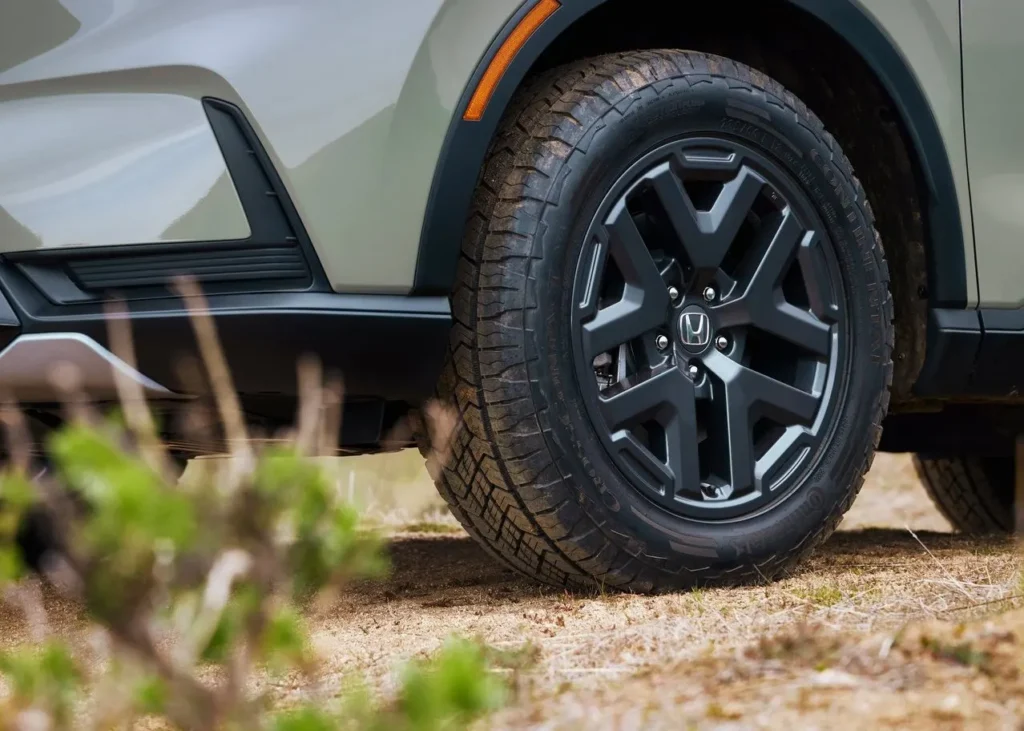
These all-terrain tires are the KEY distinguishing feature of the TrailSport. I’ll discuss them in more detail at the end of the article.
One more thing: the TrailSport is the only model in the lineup available in Ash Green Metallic. This color is pretty cool, and since it’s exclusive, it’s quite satisfying to own a car whose color isn’t commonly seen on other vehicles on the road.
Meanwhile, the Sport Touring plays the premium card. It comes equipped with larger, 19-inch gloss black wheels, paired with 235/55R19 all-season tires, making it look elegant and classy.
Interior
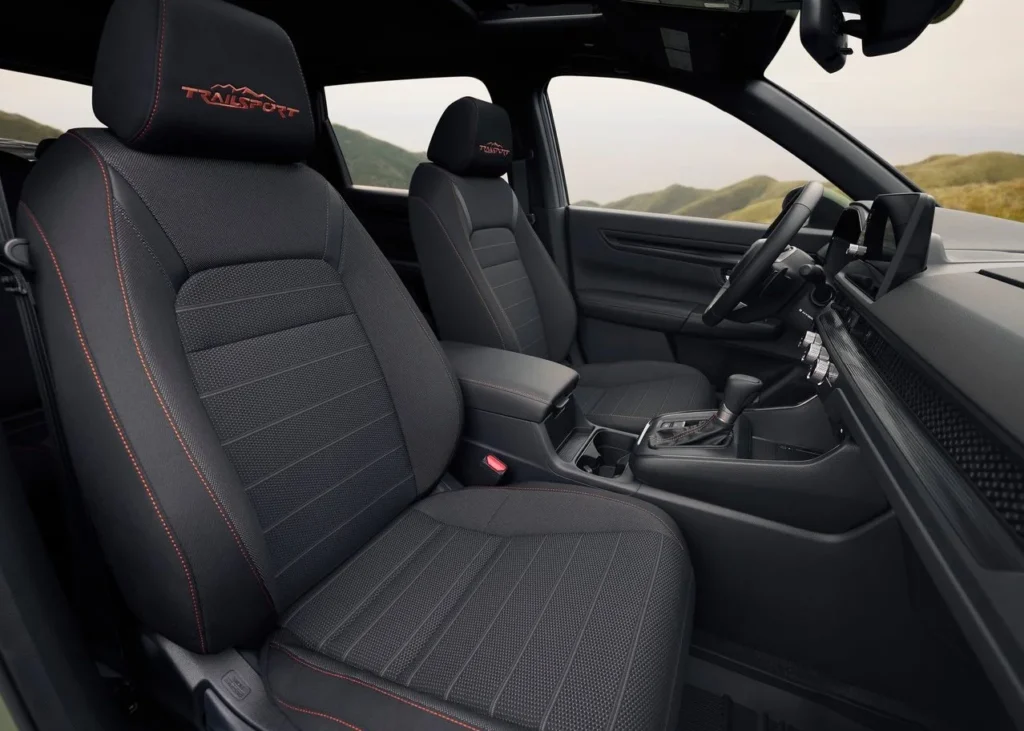 TrailSport Interior
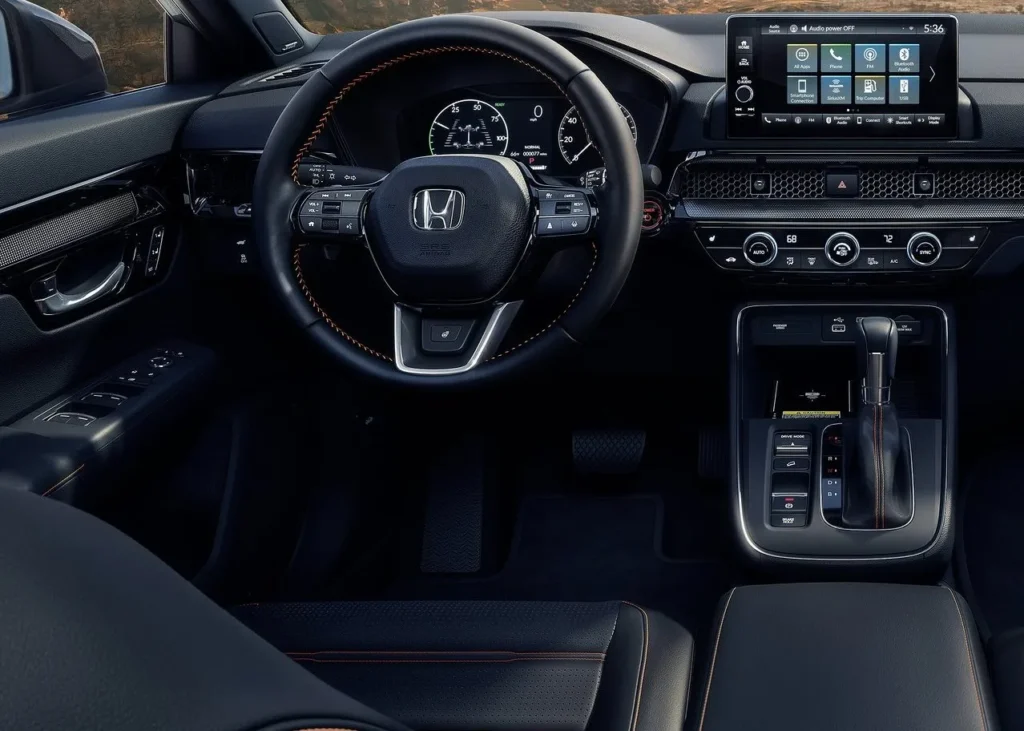 Sport Touring Interior
Similarities
Inside, both trims feel genuinely upscale compared to lower CR-V trims. You’ll find plenty of standard features in both. Both also get dual-zone automatic climate control, panoramic sunroof, and Honda’s trademark practical interior layout with excellent rear legroom (41 inches, among the best in class).
Differences
If you look inside both cars, you can immediately see some noticeable differences.
The TrailSport has an adventurous vibe, with glowing orange lighting in the footwell, door panels, and cup holders. The seats feature bold orange contrast stitching, the headrests are embroidered with the TrailSport logo, and the floor mats are molded rubber (because, obviously, you’re going to track mud in).
The seat material is cloth—supposedly premium cloth, but still just cloth.
This is disappointing, since you’ll be going on plenty of adventures with the TrailSport, and the seats might get splashed with mud or other dirt; fabric is clearly harder to clean than leather.
The Sport Touring takes a completely different direction. You get leather-trimmed seats and even ventilated front seats, whereas the TrailSport doesn’t offer these—wouldn’t it be nice to have ventilated seats while driving to a summer camping trip?
The driver’s seat has a two-position memory function, which is a real quality-of-life improvement if multiple people share the car. The front passenger seat is also power-adjustable, making it easier for your co-pilot to get comfortable.
| Interior Feature | TrailSport | Sport Touring |
|---|---|---|
| Seating Material | TrailSport Cloth | Leather-Trimmed |
| Ventilated Front Seats | No | Yes |
| Memory Driver Seat | No | Yes (2-position) |
| Ambient Lighting | Orange (themed) | Standard |
| Floor Mats | Molded Rubber | Standard |
| Headrests | TrailSport Embroidered | Standard |
| Contrast Stitching | Orange | Sport-trim orange |
Audio & Connectivity
Starting with the 2026 model year, the Honda CR-V has become the most feature-packed CR-V ever, across all trim levels.
This is especially true for the TrailSport and Sport Touring, which are, after all, the top-of-the-line trims.
Similarities
Both share many standard features, including:
- 9-inch Color Touchscreen
- 10.2-inch Digital Instrument Cluster
- Wireless Apple CarPlay
- Wireless Android Auto
- 15-Watt Wireless Phone Charger
- Bluetooth with HondaLink
- USB-C and USB-A ports
- HondaLink Subscription Services
- Wi-Fi Hotspot Capability
Differences
Although there are many similarities in standard features, this is actually one of the biggest differences between the two variants. The CR-V Sport Touring is significantly ahead in terms of audio and connectivity.
The TrailSport gets a solid 320-watt, 8-speaker audio system — it’s good enoughfor most people.
But the Sport Touring goes to a completely different level with its Bose Premium 12-speaker sound system with surround-sound technology. If you’re an audiophile, the Sport Touring is the perfect choice for you.
The other big Sport Touring exclusive is Google built-in with a 3-year unlimited data plan that bakes Google Maps, Google Assistant, and Google app access directly into the car’s infotainment system.
That means you don’t have to go through the trouble of connecting your smartphone to your car to access the Google app. Even though you can easily do that with wireless Apple CarPlay or Android Auto, the built-in Google app still offers a more seamless experience.
| Tech Feature | TrailSport | Sport Touring |
|---|---|---|
| Touchscreen | 9-inch HD | 9-inch HD |
| Instrument Cluster | 10.2-inch Digital | 10.2-inch Digital |
| Audio System | 320W / 8 Speakers | Bose® 12 Speakers |
| Google Built-in | No | Yes (3-yr plan) |
| Wireless CarPlay | Yes | Yes |
| Wireless Charging | Yes | Yes |
Safety & Driver Assistance
Both the TrailSport and Sport Touring come fully loaded with Honda Sensing, Honda’s comprehensive suite of driver-assistance features. You’re not giving anything up in this department regardless of which one you pick.
Both trims include:
- Collision Mitigation Braking System (CMBS)
- Adaptive Cruise Control with Low-Speed Follow
- Lane Keeping Assist System (LKAS)
- Road Departure Mitigation (RDM)
- Forward Collision Warning (FCW)
- Lane Departure Warning (LDW)
- Traffic Jam Assist
- Traffic Sign Recognition (TSR)
- Blind Spot Information System (BSI)
- Cross Traffic Monitor
- Auto High-Beam Headlights
- Multi-Angle Rearview Camera
Driver-assistance features such as Auto High-Beam Headlights and Rear Seat Reminder are also available.
When it comes to safety features, all CR-V models come fully equipped, including:
- Rearview Camera with Dynamic Guidelines
- Vehicle Stability Assist (VSA)
- Anti-Lock Braking System
- Electronic Brake Distribution
- Tire Pressure Monitoring System
- LED Daytime Running Lights
In addition, passive safety features such as SRS airbags, LATCH, the Post-Collision Braking System, and others are also available.
One small but practical difference: The Sport Touring comes equipped with parking sensors—a simple feature, but I’ve found it to be very helpful at times. Low-Speed Braking Control is also available on the Sport Touring. These are two useful features that are missing from the CR-V TrailSport.
Powertrain & Off-Road Capability
Next, we’ll take a look under the hood. On paper, both trims are mechanically identical in terms of power.
Shared powertrain specs:
- Engine: 2.0L Inline 4-Cylinder, Two-Motor Hybrid System
- Total System Output: 204 hp / 247 lb-ft of torque
- Transmission: Two-Stage Lockup Hybrid Transmission
- Drivetrain: AWD (standard on both)
- Drive Modes: ECON, Normal, Sport, Snow (TrailSport), + Individual (Sport Touring)
So why does the TrailSport feel more capable off-road? It comes down entirely to the tires.
The CR-V Trailsport comes equipped with all-terrain tires right out of the box. These are the TrailSport’s Continental CrossContact ATR All-Terrain tires. These tires are designed to grip uneven surfaces (gravel, dirt, mud, light snow), unlike the all-season tires on the Sport Touring, which are focused on highway driving.
That’s pretty much the only thing that makes the Trailsport stand out in terms of off-road capability. There’s no special tuning to the suspension or other supporting features. It’s a bit disappointing, considering the TrailSport’s intense off-road branding.
In terms of real-world fuel economy, the slight difference is minor but real:
- TrailSport: 38/33/35 mpg (City/Highway/Combined)
- Sport Touring: 40/34/37 mpg (City/Highway/Combined)
Although they share the same engine and drivetrain, the Sport Touring achieves better fuel economy than the TrailSport, even though it weighs 26 kg more.
The AT tires on the TrailSport create more rolling resistance, which affects fuel efficiency. However, this is an acceptable trade-off for better off-road traction.
Finally, the Sport Touring adds an exclusive Individual drive mode that lets you mix and match Normal, Sport, or Econ settings for the powertrain, steering, engine sound, and gauges.
The TrailSport gets standard four drive modes (ECON, Normal, Sport, Snow) — still plenty — but it doesn’t have this level of personalization.
Real-World Pros & Cons
Specs on paper are one thing. But what happens after you’ve driven these trims for a few weeks on real roads?
Here are some things people really like and some things that are quite bothersome about each model in everyday use.
CR-V TrailSport Hybrid
Pros
The AT tires genuinely work. The AT tires on the Trailsport really make all the difference. They provide real confidence on uneven surfaces. The combination of the all-wheel-drive system and all-terrain tires lets you step on the gas on any terrain without any problems.
Surprisingly refined on the highway. A common concern often associated with off-road vehicles is poor driving performance on paved roads. Typically, all-terrain tires produce noticeable road noise. The all-terrain tires on the Trailsport add only a slight amount of road noise—not enough to disrupt conversation.
Incredible range and efficiency for an “adventure” SUV. As a reliable vehicle for casual off-roading and camping, the fact that it achieves a combined fuel economy rating of over 30 mpg is very impressive.
The interior personality is a real differentiator. Although it’s a matter of personal taste, to be honest, I’m a fan of the orange ambient lighting, the contrasting stitching, and the headrests embroidered with the TrailSport logo.
Cons
Engine noise under hard load is real. Although this issue isn’t unique to the TrailSport, the TrailSport’s typical driving conditions—which often involve steep inclines and other challenging terrain—force the 2.0L engine to operate at high RPMs. At those times, the engine sound becomes rough and roaring, which can be quite bothersome and even frightening for some people.
The AT tires do cost you MPG and cornering feel. It’s true that AT tires reduce fuel economy by about 2 mpg, but that’s the price we have to pay. What bothers me, though, is that these tires make cornering less comfortable than with regular tires.
It’s not a real trail truck. The TrailSport doesn’t get additional ground clearance beyond the standard CR-V’s 8.2 inches, no extra underbody protection, no recovery hooks, and even no spare tire. The CR-V TrailSport is built for dirt roads, light trails, and snowy driveways — not rock crawling.
The “skid plate” is cosmetic. Some people are fooled by the silver-colored skid plate, which is actually just a styling piece, not a real skid plate.
CR-V Sport Touring Hybrid
Pros
The hands-free liftgate is genuinely useful. Waving your foot under the bumper to pop the liftgate is the kind of thing you don’t know you need until you have it. Trust me, it’s super handy when your hands are full of groceries.
Ventilated seats make a real difference in hot climates. Long drives in the summer often leave your back sticky and sweaty, but ventilated seats can help reduce this discomfort.
Google built-in works surprisingly well. Google apps like Google Maps and Google Assistant, which are directly integrated into the car’s system, run more smoothly than when using CarPlay, especially in areas with spotty cell service
Memory seat is appreciated by multi-driver households. If you frequently switch drivers—for example, if you and your partner or family members take turns driving—you don’t have to adjust the seat every time there’s a driver change. It’s simple, but surprisingly, I really enjoy it.
Cons
The Bose audio system divides opinion. This remains a point of debate among users. Some believe the audio quality is already good, while others feel it’s not yet up to par; they believe the head unit powering the Bose speakers is the limiting factor. The Bose label raises expectations that, unfortunately, the system doesn’t always fully meet.
The 19-inch wheels make the ride noticeably firmer. Using larger wheels means the tire profile becomes lower or thinner. This results in a slightly stiffer ride compared to 18-inch wheels. It’s not too bad, but you’ll notice the difference when driving on rough city streets.
The price premium adds up fast. The price of the Sport Touring, which approaches the premium segment, sometimes leads people to think and feel that the interior quality could be even better—for example, compared to something like the Kia Sorento or Hyundai Tucson, which offer a more upscale interior. The CR-V Sport Touring isn’t bad, but at that price point, it seems like it could offer more.
Software bugs on 2026 models. I found several reports from owners on Consumer Reports highlighting an issue where the text message reading function cuts off midway. This software issue cannot be resolved at the dealership; Honda may need to release a software update to address it. The problem isn’t widespread, but I thought you should know.
Price & Value
Let’s talk money.
- TrailSport Hybrid MSRP: $38,800
- Sport Touring Hybrid MSRP: $42,550
*Excluding tax, license, registration, $1,450 destination charge, and accessories.
That’s roughly a $3,750 difference. For that extra cost, the Sport Touring gives you:
- Leather-trimmed seats
- Ventilated front seats
- Memory driver seat
- Bose® 12-speaker premium audio
- Google built-in (3-year data plan)
- Individual drive mode
- Hands-free power tailgate
- Parking Sensor
- Low-Speed Braking Control
- Power front passenger seat
Meanwhile, the TrailSport gives you things the Sport Touring doesn’t:
- All-terrain tires (genuinely off-road capable)
- Orange adventure-themed interior styling
- Exclusive Ash Green Metallic color
- Lower entry price
Which Should You Buy?
Here’s my honest take — and I’m going to include something most comparison articles won’t tell you.
Buy the TrailSport Hybrid if: You want the adventure look baked in from the factory, love the orange interior aesthetic, and the lower ~$38,800 price point matters to you. The TrailSport is also the right call if you want a no-fuss, out-of-the-box package without any aftermarket work.
Buy the Sport Touring Hybrid if: You spend most of your time on regular roads and want the absolute best daily driving experience the CR-V offers — Bose audio, Google built-in, ventilated leather seats, hands-free liftgate, and memory seating. The extra ~$3,750 over the TrailSport is genuinely well spent if comfort and technology are your priorities.
The Insider Take: The Best of Both Worlds
Here’s something almost no one talks about — and it changes the calculation entirely.
After digging deep into what actually separates these two trims off-road, the honest answer is: the all-terrain tires are the only meaningful off-road advantage the TrailSport has over the Sport Touring.
Ground clearance is identical at 8.2 inches. The AWD system is the same. Hill Descent Control comes on every AWD CR-V in 2026. There are no real skid plates, no special tuning, no suspension lift, no recovery points — nothing structurally different under either car.
Which means this: If you buy a Sport Touring and replace the standard 235/55R19 all-season tires with all-terrain tires, or completely swap out the wheels for 18- or 17-inch off-road-specific wheels with AT tires, it will perform even better!
That way, you’ll effectively match the TrailSport’s off-road capabilities (or even surpass them) while retaining every premium feature the Sport Touring offers. Ventilated leather seats. Bose audio. Google built-in. Memory seat. Hands-free liftgate. All of it.
However, that will cost you extra for a set of AT tires, which usually range from $600 to $900—not to mention if you plan to get new rims.
If you already have rims with AT tires at home, you can definitely go with this option—it will significantly reduce costs—just make sure the rims have the same lug pattern as the Honda CR-V.
So, the bottom line is, if you’re buying the TrailSport solely for its off-road capability, you have another option: swap the all-season tires for AT tires, and you’ll get the same off-road capability as the TrailSport.
Of course, if the TrailSport’s aesthetic — the orange stitching, the Ash Green Metallic paint, the embroidered headrests — is part of the appeal, no tire swap replicates that. The TrailSport has a personality that money alone doesn’t fully explain.
But from a pure capability-per-dollar standpoint, the Sport Touring with AT tires is a sleeper combo worth serious consideration.
Final Word
If you love the TrailSport look and want a factory-ready adventure package at a lower price, choose the TrailSport. If you want maximum features and don’t mind a minor tire upgrade, the Sport Touring can be off-road ready while offering better comfort.
Both are excellent trims. Now you just know the full picture.
So — are you Team TrailSport, Team Sport Touring, or the Sport Touring + AT tires crowd? Drop your pick in the comments!
Pricing and specs are based on 2026 model year data. MSRP may vary by region and dealer. Always verify with your local Honda dealership.