
Honda CR-V Won’t Start: Common Causes & Fix (Gas and Hybrid)
I’ve had a car refuse to start on me in every vehicle I’ve owned. The CR-V included.
Most of the time it’s boring. Sometimes it’s a gremlin that eats a whole week of your life. Here’s what I’ve actually run into, how to tell the causes apart, and where the hybrid plays by different rules.
Start With What You Hear and See
Before you open the hood, pay attention to the first five seconds after you press the button or turn the key. Those five seconds tell you more than any parts list.
| What happens | Most likely cause | Check this first |
|---|---|---|
| Slow, lazy crank. Dash and headlights look dim | Weak 12V battery | Voltage with a multimeter, then charge or jump |
| Rapid “tick-tick-tick,” dash looks normal | Loose or corroded terminals (or a weak battery) | Wiggle both terminal clamps by hand |
| One solid click, then nothing | Starter, solenoid, or starter relay | Battery first. If it’s healthy, get the starter circuit tested |
| Total silence, dash is dead | Fully dead battery or a terminal that’s come off | Look at the battery posts |
| Dash lights up, nothing on start | Park/neutral switch, brake switch, ignition switch, or key fob | Confirm Park, press the brake firmly, try the spare key |
| Cranks normally, never fires | Fuel, spark, or a crank position sensor (CKP) | Scan for codes with an OBD reader |
| Fires, then dies right away | Immobilizer or key issue, or fuel delivery | Try the spare key, then check for fuel pressure and codes |
Use the table as a starting point. A weak battery can fake a lot of other problems, so always rule it out first.
A Drained 12V Battery
Honestly, this is the cause that got me most often. It has happened to me two different ways.
Old age. The battery had simply reached the end of its life. Nothing clever to diagnose here. I bought a new one and swapped it myself in the driveway.
If you’re at that point, check the right size before you buy. My CR-V battery size and replacement cost guide lists the group size for each generation and what a swap should cost.
My own fault. I once left a few electronics running for a long time with the engine off. Phone chargers, stereo, interior lights. Come back later and the car is dead.
That battery wasn’t worn out, just flat. I put it on a charger overnight and it came back normal. Stuck in the same spot? Here’s what to do when a CR-V battery is dead, step by step.
Quick note on what to expect from the charge. A battery that’s deeply drained once usually recovers. One that keeps going flat every few weeks is telling you it’s tired, so I’d test it before trusting it again.
Loose Terminals: The Click That Fooled Me
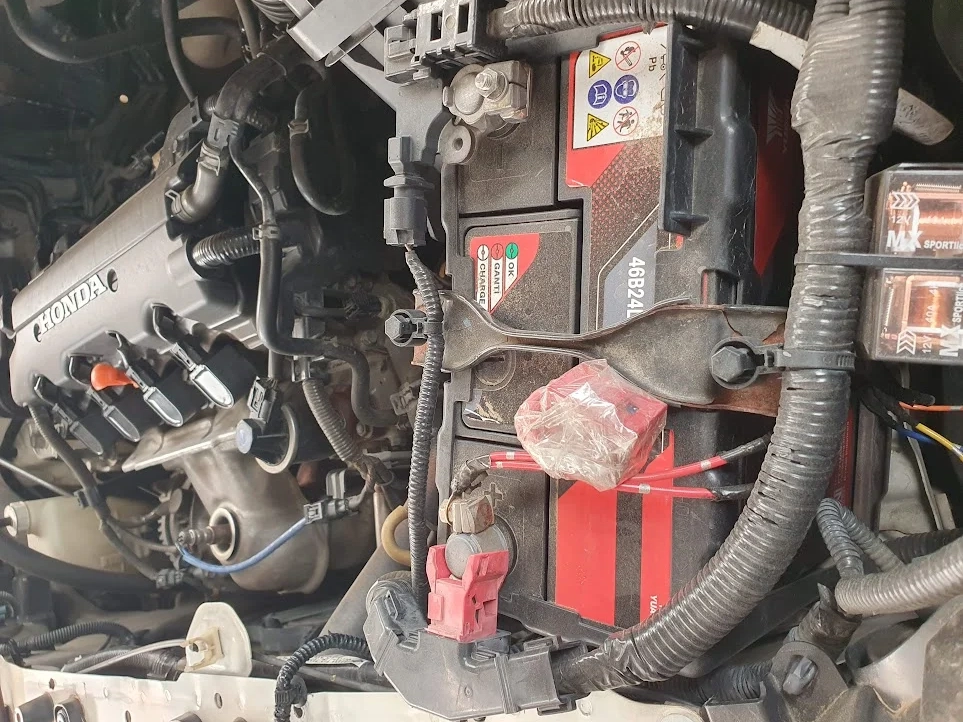
This one is sneaky. The car wouldn’t start, but the dashboard lights looked perfectly normal. Turn the key and all I got was a dry “click-click.”
The terminal clamps had worked loose. Enough power got through for the lights, but not for the starter, which pulls a lot more current.
In my experience, here’s the pattern:
- Dim dash or dim headlights: usually a drained battery
- Normal-looking dash, but clicking: check the terminals
Take that as a clue, not a rule. Plenty of owners on the forums report a weak battery that still lights up the dash fine, then clicks when asked to crank. Whichever it turns out to be, the check costs nothing. Grab each clamp and try to twist it. If it moves, tighten it and clean off any white or green crust.
A Fresh Battery Didn’t Fix It
This one fooled me completely.
I was driving an old second-generation CR-V when it refused to start. I assumed the battery had dropped, because that’s what it usually is. So I put in a brand-new, fresh battery.
Still nothing.
It took me two days of chasing the problem before I got to the answer. The starter had died.
Honestly, that’s fair. A starter doesn’t last forever, and that CR-V had plenty of years and miles on it. The part simply reached the end of its life.
Here’s the lesson. If a new or freshly charged battery doesn’t change anything, stop blaming the battery. Look at the starter next.
I’d also suggest you hand this job to a mechanic you trust. Replacing a CR-V starter is not a quick swap.
On the second-generation car I was driving, the starter sits low on the engine, underneath the intake manifold at the back. You can’t see it or reach it from above.
The intake manifold and throttle body are in the way. Several parts have to come off before you can even get at the bolts and the starter body.
If you want to test your own starter before paying for anything, this ChrisFix video is a good place to start. It shows how to check whether the starter is what’s keeping your car from starting.
The Sensor That Cost Me Days
This is the story I’d like you to avoid repeating.
My 2015 CR-V with the 2.4L K24 engine cranked fine but wouldn’t fire. No sputter, no cough. Nothing.
I had no OBD reader at the time, so I did what stubborn people do: I started pulling parts. Spark plugs. Injectors. Coils. Days went by.
A friend finally showed up with a scanner. The code was P0339, which points at the crank position sensor circuit (CKP).
The sensor itself wasn’t dead. Its wiring had broken somewhere, for reasons I never figured out. I spliced it, and the car fired right up.
Here’s the part that makes me wince. That sensor is a pain to reach. It sits low on the engine, right above the exhaust pipe, so you’re working in a tight, hot spot with almost no room for your hands.
There’s also a cover over it, held on by two 10mm bolts. Get those off first, and only then can you see the connector and wiring.
That’s on the 2015 K24. Other engines and model years may place it differently, so check a repair manual or a model-specific video before you crawl under yours.
Either way, plan on ramps or a jack with stands, and let the engine cool down first.
Had I plugged in a scanner on day one, I’d have saved myself days of pulling parts. A basic OBD reader costs less than one of the injectors I removed. If your CR-V cranks but won’t start, scan it before you touch a single part.
Water Where It Shouldn’t Be
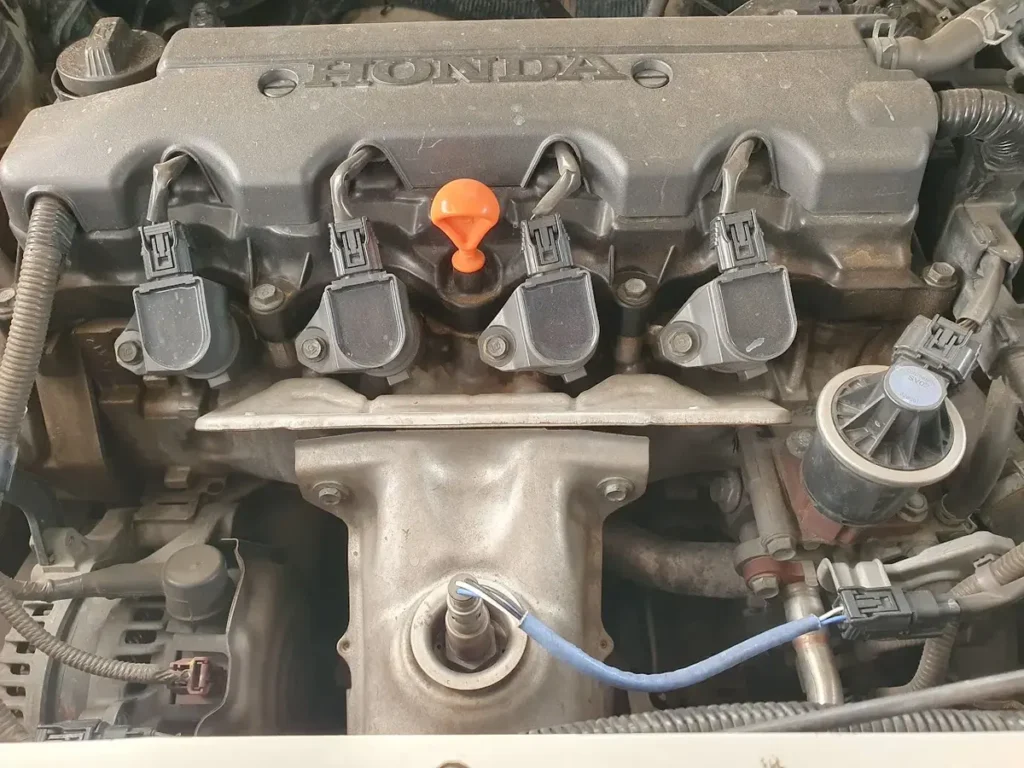
This one isn’t a no-start, but it belongs here. My Honda Fit (not CR-V) started misfiring after I washed the engine bay while detailing. One ignition coil connector had taken on water.
The engine kept running, just badly. Had it been a worse soaking, I could easily have ended up with a car that wouldn’t start at all.
If you detail your engine bay, cover the coil connectors and the electrical plugs. Skip the pressure washer in there. And if a misfire starts right after a wash, check the connectors first.
Other Causes Worth Knowing About
These haven’t bitten me personally. They come up again and again in owner reports and in Honda’s own recall records, so I’d rather you know about them.
- Second-generation ignition switch (roughly 2002–2007). Owners report total silence when turning the key. If the switch’s internal contacts wear out, power never reaches the starter.
- Parasitic battery drain on 2012–2014 models. Some owners traced mysterious dead batteries to software. A dealer visit for the latest updates is worth it if your battery keeps dying.
- Starter relay and intermittent push-button starting (2012–2016 era). Forum threads are full of CR-Vs that click, then start on the third or fourth press. Annoying, and it tends to get worse.
- In-tank fuel pump recall. Honda issued a recall covering many 2013–2023 CR-Vs for pumps that can fail and stall the engine. Put your VIN into the NHTSA recall lookup. It’s free and takes a minute. The details are in my CR-V recalls guide.
- Wrong gear selection or a dirty park switch. Simple, but worth ruling out before you pay anyone.
The Hybrid Works Differently
My hybrid time is mostly as a passenger and test driver, so I’ll stay with what the manuals and owner reports agree on.
You don’t listen for a crank. You look for the READY light. (Not sure what it looks like? My dashboard symbols guide shows it.)
Press the button with your foot on the brake. If READY comes on, the car is “started,” even though the gas engine may stay silent. That’s normal. It’s why the hybrid feels so smooth in stop-and-go traffic.
Here’s the part that surprises people. The big hybrid battery isn’t what wakes the car up. The ordinary 12V battery is. It’s a regular battery, and when it wears out you replace it like any other. Start with the battery size guide.
It powers the computers and relays that bring the high-voltage system online. When it’s weak, the dash might light up, but READY never appears.
| Hybrid symptom | Likely cause | Check this |
|---|---|---|
| Dash lights up, no READY | Low 12V battery | Jump the 12V (see below) |
| Dash is dim or flickers | Failing 12V battery | Test voltage |
| Nothing happens at all | Dead 12V or fob problem | Try the spare fob held to the start button, and check the fob battery |
| READY won’t appear after a good jump | Hybrid system fault | Look for warnings, then call a dealer |
Two details matter here.
First, there’s no traditional alternator. A DC-DC converter charges the 12V battery from the hybrid battery while the car is in READY mode. If the 12V is dead, the car can’t recharge itself.
Second, jump the 12V only. Honda’s hybrid manual has a dedicated section on a dead 12V battery with the connection order. Follow that, and don’t improvise.
Don’t touch anything with orange cabling. That’s the high-voltage system.
If you jump the 12V correctly, the READY light still won’t come on, and warnings appear on the cluster, stop there. That points past the 12V battery.
One more thing for hybrid owners. A few 2023 CR-V Hybrids were recalled for an e-CVT part that can cause a no-restart condition. Run your VIN on NHTSA’s recall page. It’s the cheapest diagnostic you’ll do all year.
My Order of Operations
When a CR-V won’t start, I go through the same sequence every time:
- Check Park, press the brake, and try the spare key or fob. A weak fob battery can stop the car from recognizing the key, and the key fob battery guide walks through the swap
- Look at the dash. Dim or bright?
- Wiggle and inspect both battery terminals
- Measure the battery. A healthy 12V battery sits around 12.4 to 12.7 volts at rest
- Charge or jump it
- If it cranks but won’t fire, scan for codes before replacing anything
Most no-starts end at step 3 or 4. The ones that don’t are the reason you should own a cheap OBD reader.
I keep a charger and a basic scanner in the garage now. Neither cost much, and I haven’t spent a week pulling the wrong parts since. If you’re driving an older CR-V and haven’t checked your battery age lately, do it this weekend, before the car decides for you.