
CR-V Rough Idle & Vibration on Cold Start: Causes and Fixes
It’s a cold morning. You start your CR-V, and the steering wheel starts buzzing in your hands.
The seat shakes. The rearview mirror goes blurry. But the tachometer is rock steady and there’s no check engine light.
Ten minutes into the drive, it’s mostly gone. By the time you park, you’ve almost forgotten about it.
If you’ve searched for this, you’ve seen the same list everywhere: vacuum leak, dirty throttle body, bad PCV valve, clogged injectors, misfire.
Those are real causes. But they make the engine run badly. What I’m talking about is different: an engine that runs fine but shakes the whole car anyway.
In my experience, that’s usually an engine mount.
Rough Idle vs. a Shaking Cabin: Two Different Problems
I separate these two right away, because they send you down very different repair paths.
Signs the engine itself is the problem:
- RPM hunts, dips, or surges at idle
- Stumbling, hesitation, or a misfire you can hear from the tailpipe
- Check engine light, flashing or steady (see our CR-V dashboard symbols guide)
- Raw fuel smell or a sudden drop in gas mileage
Signs the mounts are the problem:
- RPM is steady, no codes, engine pulls normally
- You feel it more than you hear it: steering wheel, seat, floor
- Worst on a cold start, or when stopped in Drive
- Fades once the car is warm and moving
If your car fits the second list, keep reading. Cleaning the throttle body won’t do anything for you.
What I Found on My Own Car
Full disclosure: the car that triggered this article isn’t my CR-V. It’s my Honda Fit.
This morning I started it, and the whole cabin shook hard. The steering wheel was the worst part. Engine idle was smooth on the gauge, no codes, no misfire.
Here’s what it looked like from the driver’s seat:
Note: While demonstrated on a Honda Fit, this same upper mount failure mode causes identical steering wheel vibration on 3rd, 4th, and 5th-gen CR-Vs.
The cause was the upper engine mount. That’s the one carrying most of the engine’s weight, and its rubber had collapsed.
Here’s a healthy mount next to a collapsed one. Look at how much height the failed rubber lost:
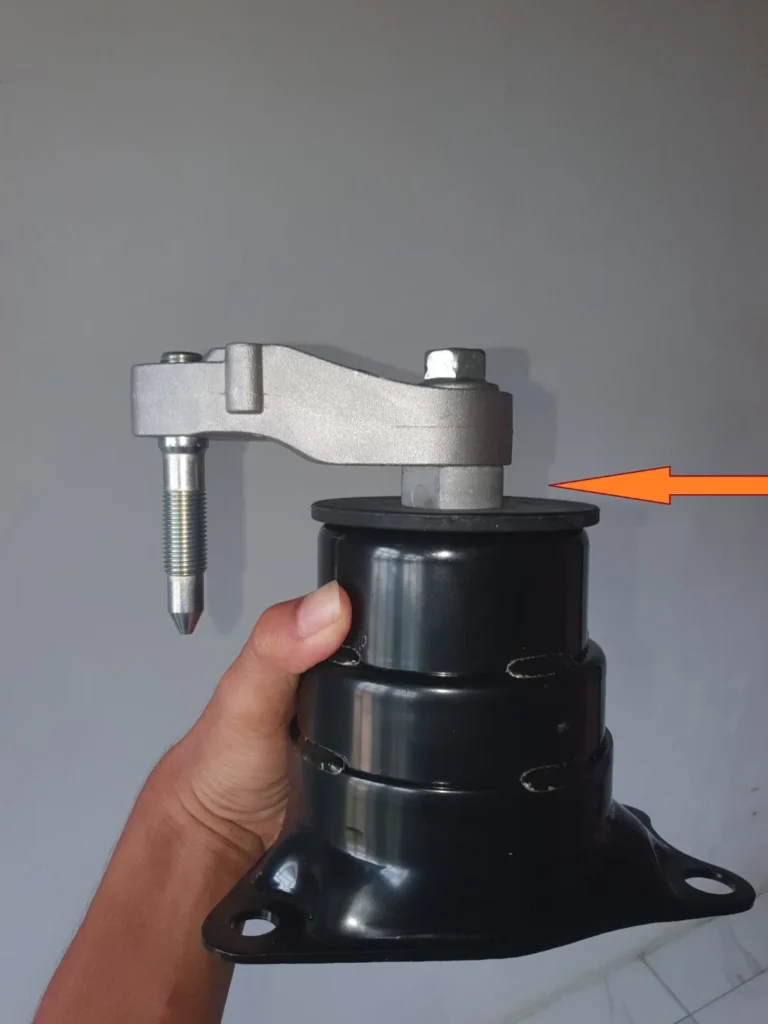 Good engine mount
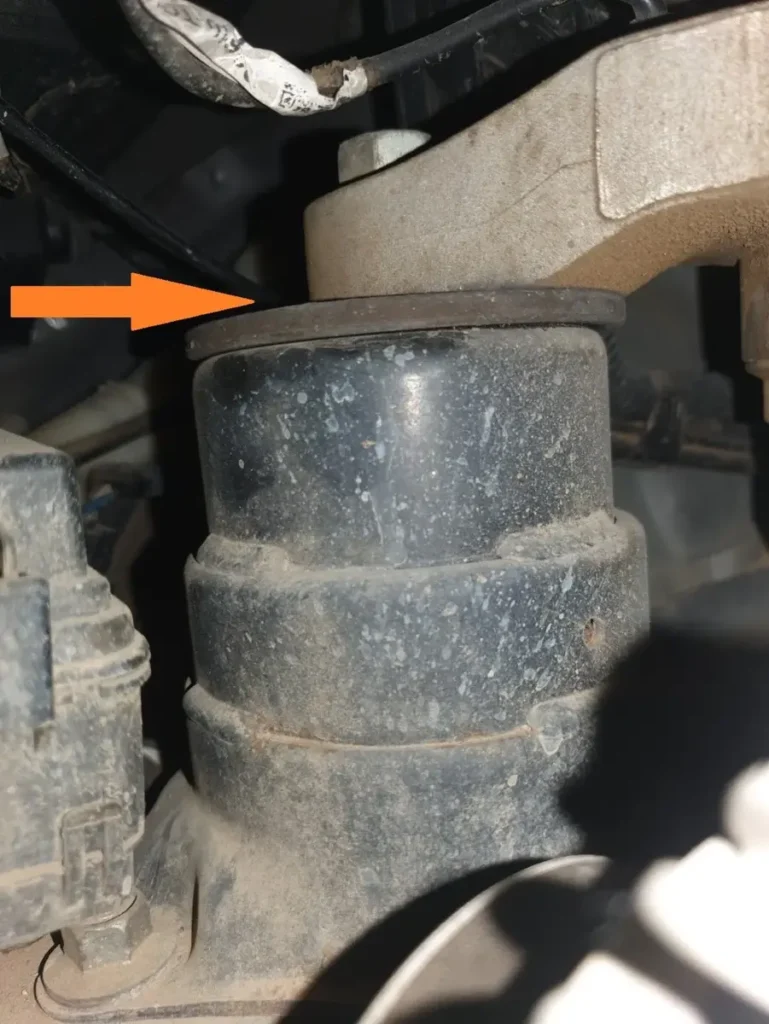 collapsed engine mount
Honda CR-V bad engine mount vs good OEM mount height comparison
Same Honda design philosophy, same failure. Every CR-V generation uses rubber and fluid-filled mounts that age the same way.
Why a Worn Mount Feels Worse on Cold Mornings
An engine mount is a block of dense but flexible rubber bonded to metal brackets. Its whole job is to soak up engine vibration before it reaches the body.
Over time, heat cycles and engine weight do two things. The rubber hardens, and the load-bearing mount sags.
Cold weather makes both problems worse. Owners on Bob Is The Oil Guy point out that mounts stiffen in the cold, and that CR-V engine NVH feels noticeably different between winter and summer.
An Acura owner reported the same pattern. The explanation from other members: cold, stiff rubber plus a slightly rougher-running cold engine, until everything warms up.
Then there’s engine speed. A cold engine idles higher while it warms the catalytic converter, and combustion isn’t as smooth yet.
That shifts the vibration frequency. Sometimes it lands right on the cabin’s resonance point.
You can see this in owner complaints. One 2016 CR-V owner noticed the vibration disappears when idle RPM rises slightly in Drive, just from switching on the fan or rear defroster.
It cuts both ways, though. A 2013 owner on BITOG said his first morning start usually doesn’t vibrate because the idle is higher. Different car, different resonance point. Same root cause.
A collapsed mount adds one more thing. With less rubber height, the metal parts sit closer together, so the isolator stops isolating.
Once the car warms up and you’re driving, the rubber softens, the engine shifts position under torque, and road noise masks whatever’s left.
Where the Mounts Are on a CR-V
A CR-V’s engine sits on several mounts. Exact designs vary by generation, but the general layout is consistent.
- Passenger-side engine mount: A fluid-filled (hydraulic) mount on most generations, and the most important one for vibration damping. It carries much of the engine’s weight.
- Driver-side transmission mount: Tucked under the air intake assembly. Newer CR-Vs (2017+) use a fluid-filled design here too.
- Front and rear mounts / torque struts: These control the engine rocking forward and back under load.
On the 2012–2014 generation, owners report an active front mount controlled by engine vacuum. If your CR-V has one, a cracked vacuum line can mimic a failed mount.
How I Check Before Spending Money
Mounts aren’t cheap to replace on some CR-Vs, so I rule things out in order.
1. Confirm the engine is actually healthy. Plug in a cheap OBD2 scanner. Check for pending codes, watch live RPM, and look at misfire counters if your scanner shows them.
If your plugs are overdue, check our CR-V spark plug guide first. EricTheCarGuy’s advice holds up: make sure the engine runs right before touching mounts, especially since the rear one is a real pain to replace.
2. Compare Neutral vs. Drive on a cold start. If the shaking gets noticeably worse in Drive with your foot on the brake, the mounts are under torque load. That’s a strong hint.
3. Try the accessory test. Turn on the AC or rear defroster. If a small RPM change dramatically changes the vibration, you’re dealing with resonance through the mounts, not combustion.
4. Look at the mounts. Use a flashlight. Look for cracked rubber, rubber separating from the metal, or a mount that looks squashed. On hydraulic mounts, dark oily fluid seeping out means it’s done.
5. Do the rock test with a helper. Hood open, parking brake set, foot firmly on the brake. Have someone shift between Drive and Reverse while you watch the engine.
A healthy engine moves a little. A bad mount lets it lift or lurch.
If you’re shopping for a used CR-V, add this test to your inspection. It takes two minutes, and we cover the rest of the checklist in our used CR-V buying guide.
CR-V Cases That Look Like a Bad Mount (But Aren’t Only That)
This is where CR-V owners need to be careful. Honda has documented a few vibration issues that overlap with mount symptoms.
2015 CR-V: TSB 15-046
The 2015 model was the first CR-V with a CVT, and it drew plenty of idle vibration complaints. Honda responded with service bulletin 15-046 for vibration while driving or stopped in gear.
The fix depends on when you feel it:
- Mode 1: New radiator lower cushions, transmission mount, and front head restraints
- Mode 2: PCM software update plus a tailgate damper kit
- Mode 3: PCM software update only
Results were mixed. One owner on CarComplaints said it helped, but the car still shook in Drive at stoplights with idle dipping to about 550 rpm.
If you own a 2015, ask your dealer whether the bulletin was done before replacing anything.
2023 CR-V Hybrid: Cold Start Below 32°F
This one is a true engine issue, not a mount. A Honda Tech Line article covers 2023 CR-V Hybrid and Accord Hybrid models with a slight misfire vibration on cold starts at 32°F or below, logged with code P0700.
It typically goes away once the engine warms up. Honda’s interim advice is to drive at least five minutes each trip, since short drives followed by long cold soaks can trigger it.
The difference from a mount problem is clear: you’ll have a check engine light. More hybrid-specific quirks are in our CR-V Hybrid problems article, and open campaigns are listed in our CR-V recall history.
2011 CR-V: Exhaust Hangers
I like this one because almost nobody mentions it. Autodata documented a 2011 CR-V with idle and light-throttle vibration that got worse in cold weather.
The cause wasn’t the engine at all. The rear muffler’s rubber hangers were over-compressed because the brackets sat in the wrong position. Moving one bracket up 2–3 mm and the other down 2–3 mm fixed it.
The lesson: anything rubber that connects the engine or exhaust to the body can carry vibration into the cabin.
Fixing It: Cost and Parts Choices
RepairPal puts CR-V engine mount replacement at $751–$835. Treat that as a ballpark, since one easy side mount costs far less than a full set.
Replace the mount that’s clearly failed, and inspect the rest while you’re in there. A collapsed main mount puts extra load on the others.
On the hydraulic passenger-side mount, I’d spend the money on genuine Honda. That’s the mount doing most of the damping work.
Cheap aftermarket mounts may fit fine and still feel worse. If the rubber compound is too stiff, you’ll trade a collapsed mount for a different vibration.
One warning, though. A new mount won’t fix an engine that’s actually running rough. I’ve seen owners replace a mount for idle shake, only to find the shaking still there afterward.
That’s why steps 1 through 3 above come first.
Is It Safe to Keep Driving?
In the early stage, it’s mostly a comfort problem. Your car won’t leave you stranded because a mount is tired.
But a collapsed mount lets the engine move more than it should. That stresses the other mounts, the axles, radiator hoses, and exhaust joints.
If you start hearing a clunk when shifting into Drive or Reverse, or feel a jolt when you accelerate, don’t wait.
Mounts aren’t on Honda’s maintenance schedule, but on a CR-V past 100,000 miles, I’d give them a look at every oil change. They’re one of the quiet reasons a high-mileage CR-V starts to feel old.
What About Vibration While Driving?
That’s a different problem, and I’ll cover it in its own article.
A quick preview: worn suspension parts, a tire with a bulge in the sidewall, and a very CR-V-specific issue, warped front brake rotors, all show up as vibration on the road. Low tire pressure won’t help either.
For now, the next cold morning your CR-V shakes, pull up the tach. If the needle sits still while the steering wheel buzzes, you already know where to look.