
Honda CR-V Oil Guide: Capacity, Type, Maintenance (1997-2026)
Never take an oil change lightly, especially for modern engines like the 1.5L turbo in your CR-V.
You need to make absolutely sure of the type of oil, the viscosity specs, and even the oil capacity you’re putting into the engine; otherwise, be prepared to face significant repair costs down the road.
In this guide, I’ll walk you through everything you need to know about changing the oil in your CR-V, including capacity, viscosity, filters, and expert brand recommendations.
Quick Reference: Oil Capacity & Viscosity Table
| Model Year | Oil Capacity (w/ Filter Change) | Recommended Viscosity |
|---|---|---|
| 2026 | 2.0 L4-cyl (Hybrid): 4.2 qt. (4.0 L) 1.5 L 4-cyl: 3.7 qt. (3.5 L) | 0W-20 |
| 2025 | 2.0 L4-cyl (Hybrid): 4.2 qt. (4.0 L) 1.5 L 4-cyl: 3.7 qt. (3.5 L) | 0W-20 |
| 2024 | 2.0 L 4-cyl (Hybrid): 4.2 qt. (4.0 L) 1.5 L 4-cylinder: 3.7 qt. (3.5 L) | 0W-20 |
| 2023 | 2.0 L 4-cyl (Hybrid): 4.2 qt. (4.0 L) 1.5 L 4-cyl: 3.7 qt. (3.5 L) | 0W-20 |
| 2022 | 2.0 L 4-cyl (Hybrid): 4.0 qt. (3.8 L) 1.5 L 4-cyl: 3.7 qt. (3.5 L) | 0W-20 |
| 2021 | 2.0 L 4-cyl (Hybrid): 4.0 qt. (3.8 L) 1.5 L 4-cyl: 3.7 qt. (3.5 L) | 0W-20 |
| 2020 | 2.0 L 4-cyl (Hybrid): 4.0 qt. (3.8 L) 1.5 L 4-cyl: 3.7 qt. (3.5 L) | 0W-20 |
| 2019 | 2.4 L 4-cyl: 4.7 qt. (4.4 L) 1.5 L 4-cyl: 3.7 qt. (3.5 L) | 0W-20 |
| 2018 | 2.4 L 4-cyl: 4.7 qt. (4.4 L) 1.5 L 4-cyl: 3.7 qt. (3.5 L) | 0W-20 |
| 2017 | 2.4 L 4-cyl: 4.7 qt. (4.4 L) 1.5 L 4-cyl: 3.7 qt. (3.5 L) | 0W-20 |
| 2016 | 4.6 qt. (4.4 L) | 0W-20 |
| 2015 | 4.6 qt. (4.4 L) | 0W-20 / 5W-20 |
| 2014 | 4.2 qt. (4.0 L) | 0W-20 / 5W-20 |
| 2013 | 4.2 qt. (4.0 L) | 0W-20 / 5W-20 |
| 2012 | 4.2 qt. (4.0 L) | 0W-20 / 5W-20 |
| 2011 | 4.4 qt. (4.2 L) | 0W-20 / 5W-20 |
| 2010 | 4.4 qt. (4.2 L) | 0W-20 / 5W-20 |
| 2009 | 4.4 qt. (4.2 L) | 0W-20 / 5W-20 |
| 2008 | 4.4 qt. (4.2 L) | 0W-20 / 5W-20 |
| 2007 | 4.4 qt. (4.2 L) | 0W-20 / 5W-20 |
| 2006 | 4.4 qt. (4.2 L) | 5W-20 / 5W-30 |
| 2005 | 4.4 qt. (4.2 L) | 5W-20 / 5W-30 |
| 2004 | 4.4 qt. (4.2 L) | 5W-20 / 5W-30 |
| 2003 | 4.4 qt. (4.2 L) | 5W-20 / 5W-30 |
| 2002 | 4.4 qt. (4.2 L) | 5W-20 / 5W-30 |
| 2001 | 4.0 qt. (3.8 L) | 5W-30 |
| 2000 | 4.0 qt. (3.8 L) | 5W-30 |
| 1999 | 4.0 qt. (3.8 L) | 5W-30 |
| 1998 | 4.0 qt. (3.8 L) | 5W-30 |
| 1997 | 4.0 qt. (3.8 L) | 5W-30 |
Why Full Synthetic?
Today, there are three types of oil commonly used: conventional oil, fully synthetic oil, and semi-synthetic oil.
The main difference among the three is their base material. The base material of conventional oil is 100% mineral oil that is refined and purified to produce high-quality oil. This process is carried out without any molecular changes.
Fully synthetic oil, on the other hand, undergoes further chemical processing, resulting in oil with much better performance, stability, and consistency. This type of oil usually contains metal protection additives, which are not found in conventional oil.
Semi-synthetic oil, meanwhile, is a combination of synthetic and conventional base oils.
Compared to other types of oil, fully synthetic oil has several advantages, including:
- It has optimum protection at low and high temperatures.
- Keeps the engine clean, thanks to additives.
- Has higher heat resistance (suitable for modern turbo engines such as your Honda CR-V).
- Improves fuel efficiency.
- It has a longer oil change interval than mineral or semi-synthetic oils.
Compared to other types of oil, fully synthetic oil has several advantages, including:
Fully synthetic oil is the best choice if you want your engine to get the best lubrication and protection.
However, fully synthetic oil is usually more expensive than conventional and semi-synthetic oil.
Although conventional oil is cheaper upfront, it doesn’t meet the needs of modern Honda CR-V engineering. That’s why fully synthetic oil is the only option to consider for your CR-V, especially if you drive a newer model.
Understanding Oil Viscosity: 0W-20 vs. 5W-30
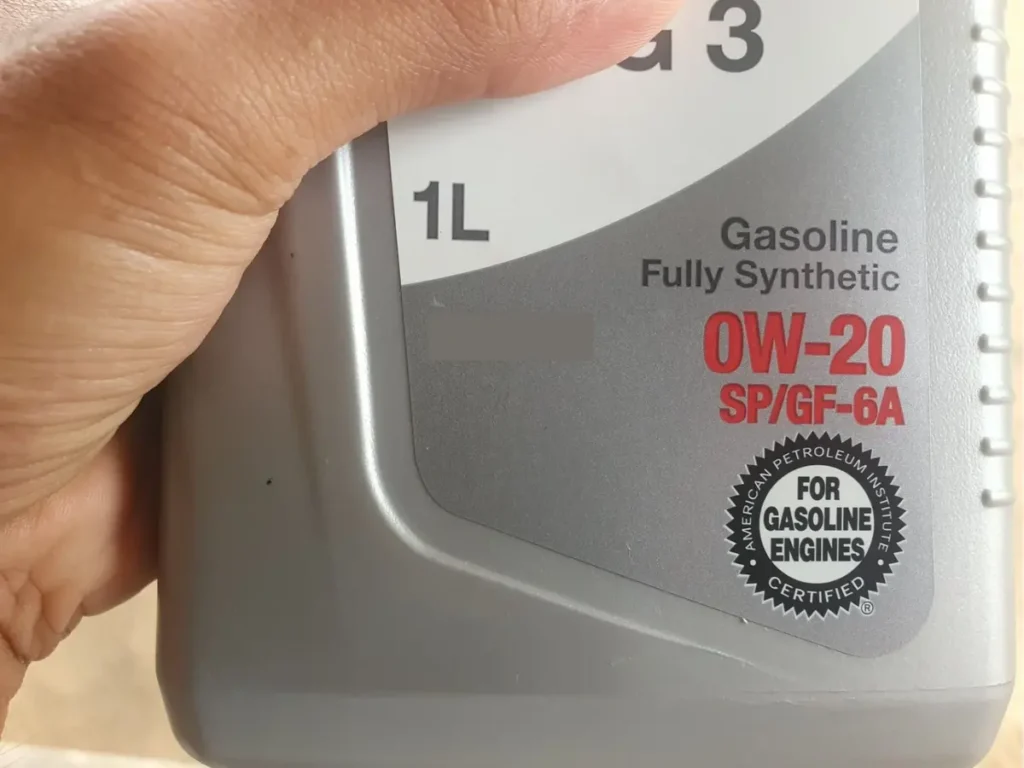
Another thing to consider before buying engine oil is viscosity. Apart from the base material, engine oils are also differentiated based on their viscosity levels.
In short, oil viscosity is the “thickness” or “thinness” of the oil.
It is expressed with numbers and “W” letters: 0W-20, 5W-30, 15W-40, and many more.
The smaller the number before the letter “W”, the thinner the oil viscosity in cold conditions, which means that the oil can spread throughout the engine well when the engine is first started.
Meanwhile, the number after the letter “W” shows how thick the oil is when the engine is running “hot”.
Which one is the best?
Well, it depends on the specifications of your vehicle’s engine. That is why it is important to read the manual and see which oil is best for your vehicle.
For the Honda CR-V, they will mostly take 0W-20 oil. Some old models will need higher viscosity, like 5W-30.
Specifically for hybrid engines, they rely heavily on low-viscosity 0W-20 oil to ensure a smooth transition from the gasoline engine to the electric motor.
However, in certain areas with hotter temperatures, such as tropical and desert regions, many mechanics recommend switching to oil with a viscosity of 5W-20 or 5W-30. This is because in areas with hot climates, the evaporation of 0W-20 oil will be quite high, so 5W-30 oil is considered more suitable.
To make it easier for you, here are the recommended viscosities for the Honda CR-V for each generation.
| CR-V Generation | Recommended Viscosity | Type |
| Gen 6 (2023 – Present) | 0W-20 | Full Synthetic |
| Gen 5 (2017 – 2022) | 0W-20 | Full Synthetic |
| Gen 4 (2012 – 2016) | 0W-20 | Full Synthetic |
| Gen 3 (2010-2011) | 0W-20 | Full Synthetic |
| Gen 3 (2007 – 2009) | 5W-20 | Synthetic Recommended |
| Gen 2 and older | 5W-20 | Synthetic Recommended |
Pro Tip: Check the oil cap under your hood; Honda prints the required viscosity right on the cap!
When to Change?
Now that you know what kind of oil your CR-V needs, you are ready to buy oil for your next oil change.
So, when should you change the oil in your Honda CR-V?
If you drive a modern CR-V (2007 to present), it is equipped with a Maintenance Minder System.
The system calculates oil life based on engine operating conditions such as idling, temperature, speed, and other factors.
When oil life is less than 15%, a warning message will appear every time you turn the ignition switch to on, reminding you to schedule an oil change for your CR-V immediately.
- 15% Oil Life: It’s time to schedule your appointment.
- 5% Oil Life: Service is due now.
- 0% Oil Life: Service is overdue; potential engine wear is occurring.
The “Golden Rule” for Mileage
If you prefer to look at mileage and time, like me, you can follow the recommendations of most mechanics below:
If you drive normally, without a lot of traffic jams, without driving in the mountains, and so on, change your oil every 7,500 to 10,000 miles.
However, if your driving habits involve frequent stop-and-go traffic, driving in the mountains, living in extreme cold/hot conditions, or frequent towing, you should change your oil every 5,000 miles.
Expert Note for 1.5T Engines: If you frequently make short trips in cold weather, gasoline can seep into the oil. Be sure to check the dipstick regularly. If the oil level appears to have “risen” or there is a strong gasoline odor, change the oil immediately, even if the Maintenance Minder hasn’t reached 0%.
Best Oil Brands for Honda CR-V
If your Honda CR-V is still under warranty, I recommend that you continue to have your oil changed at a Honda dealer.
Dealers usually use Honda OEM oil, which is fine and has guaranteed quality.
However, the fact that you are currently reading this article means that you are looking for oil alternatives other than dealer oil, right?
I am the same way. For the past 3 years, I have not gone to the dealer just to get an oil change. I buy oil that is of equal or even better quality than what the dealer uses.
So, what is the best brand of oil for the Honda CR-V?
Well, I can’t recommend a specific brand because you’re free to choose any brand as long as the oil meets Honda’s specifications.
However, it’s a good idea to go with a brand you’ve heard of before. I don’t recommend buying oil from a brand that’s unfamiliar to you.
Some engine oil I can recommend include:
- Castrol Edge 0W-20 Advanced Full Synthetic
- Mobil 1 0W-20 Extended Performance
- TotalEnergies Ineo Xtra Long Life 0W-20 Full Synthetic
- Motul Specific 5122 0W-20
- Valvoline Advanced Full Synthetic 0W-20
- Liqui Molly Top Tec 0W-20
- STP Maximum Performance Full Synthetic 0W-20
- Royal Purple High Performance Full Synthetic 0W-20
How To Reset Oil Life on Your Honda CR-V
After changing the oil, the mechanic will reset the oil life to 100% and the system will recalculate from scratch.
If the mechanic forgets to do this, or if you change the engine oil yourself, here’s how to reset the oil life on your CR-V.
2017-2022 Model year
- Press the “i” button on your steering wheel.
- Select the wrench icon using the right arrow and press Enter. You’ll see the oil life percentage.
- Press and hold Enter until the maintenance reset appears.
- Select all due items and press enter.
- You’re done.
2023-2026 Model Year
- Use the thumbwheel on the right side of the steering wheel
- Scroll to the Maintenance menu
- Press and hold the thumbwheel until the reset menu appears.
FAQs
Conclusion: An Investment in Longevity
Changing your oil on time and using the right specs is probably the cheapest insurance policy you can buy for your CR-V.
Fresh engine oil that meets your engine’s needs will ensure that your engine is well protected, allowing you to drive your Honda CR-V for a very long time.
If you have any further questions about your Honda CR-V’s engine oil, or if you want to share your experience, feel free to leave a comment below!