
Honda CR-V Heater Not Working (Diagnosis & Fix)
Your CR-V’s fan works, the AC is fine, but the heat never shows up. Before you book a heater core replacement, stop.
That’s the most expensive fix on the list, and it’s rarely the problem. A five-minute test under the hood narrows it down fast.
Start With the Two-Minute Test
Turn the engine on and let it warm up. Set the temperature to full hot, then full cold, and listen and feel.
If the air temperature never changes, no matter where the knob sits, your coolant side may be perfectly healthy. The air is simply not being steered through the heater core.
Now pop the hood. Find the two heater hoses running to the firewall.
Touch them carefully. They can be hot enough to burn you, and the engine bay has belts and fans that don’t care about your sleeves.
What the Hoses Are Telling You
| What you feel | What it likely means |
|---|---|
| Both hoses hot, cabin air stays cold | Blend door or actuator problem |
| Both hoses lukewarm or cold | Thermostat, low coolant, or air in the system |
| Inlet hose hot, outlet hose cold | Clogged heater core |
This is the same shortcut a mechanic uses in this repair video on a 2011 CR-V from the Grumpy old mechanic channel. Both hoses were hot, and that pointed straight at the blend door, not the heater core the customer had asked to replace.
Hot hoses mean hot coolant is reaching the core. The heat exists. It just isn’t getting into your cabin.
Cause #1: Blend Door Actuator
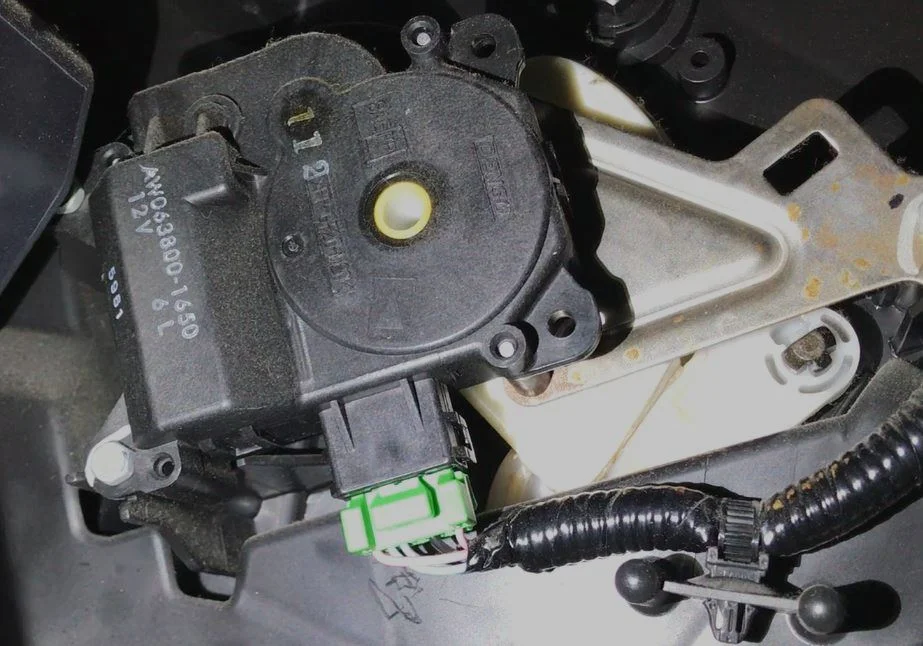
The blend door is a flap behind the dash that mixes hot and cold air. A small electric motor, the actuator, moves it.
Inside that motor is a plastic gear. This little gear breaks and produces a clicking sound.
The pattern I kept seeing in threads and repair videos was the same. Clicking or knocking from behind the dash, then temperature that won’t change, then no heat at all because the door is parked on the cold side.
One repair-cost site lists a lack of heat or AC, and air missing from some vents, as classic symptoms. It adds that driving with a bad actuator is uncomfortable but won’t damage the car.
Free Things to Try First
One mechanic suggests a trick that costs nothing. With the car on and the blower running, find the actuator and try nudging its white plastic piece.
If it doesn’t move at all, unplug the wiring harness, then plug it back in. Sometimes it wakes up. He admits it may or may not work, but it takes a minute.
Also check the fuses before you buy parts. A dead circuit can look exactly like a dead actuator.
When Both Heat and AC Seem Dead
Some owners get the opposite complaint. Hot or cold, the air coming out feels the same, lukewarm and unchanged.
That’s usually the blend door again. It controls the mix for both functions, so a stuck actuator can wreck heating and cooling at the same time.
Which way it sticks decides what you notice. Stuck on the hot side, your AC blows warm. Stuck on the cold side, you lose the heater.
The quick check from the same video applies here. With the car on and the blower running, look at the actuator’s white plastic arm. If it won’t move at all, unplug the harness and plug it back in.
Keep one distinction in mind. Air that comes out at the wrong temperature points to the blend door. No air at all points to the blower motor, a fuse, or a resistor.
If the AC compressor never clicks on and the air stays warm even when the actuator is moving, that’s a separate AC problem. My CR-V AC not blowing cold guide covers it.
Replacing It on a 2007–2011 CR-V
The actuator lives under the driver’s side of the dash, and the video walkthrough shows it’s more annoying than difficult.
The accelerator pedal sits in the way. Two 12 mm bolts hold it, and once those are out you can swing the pedal aside.
The actuator itself is held by a few screws, Phillips-head in his case, plus one electrical connector. One screw is hidden and you’ll bend your neck to find it.
While Honda’s factory service manual recommends an electronic reset procedure for the climate control unit, many experienced technicians find that the system self-calibrates after a few ignition cycles.
That’s one mechanic’s experience, so treat it as a data point, not a rule. If your new actuator doesn’t sweep through its full range, check your manual.
The location and screw count differ on other generations. Don’t assume the 2011 steps match your car.
What It Costs
One estimator puts the average CR-V blend door actuator replacement at roughly $219 to $252. For a 2023 model, the same site shows about $158 to $203.
Cause #2: Thermostat Stuck Open
If the hoses are only warm and the temperature gauge sits low, suspect the thermostat. It lets coolant bypass the radiator until the engine warms up, and a stuck-open one never lets the engine get there.
On older CR-Vs, a go-to symptom is a slow-to-warm engine or a heater that blows cool air. A common code for it is P0128, coolant temperature below thermostat regulating temperature.
It’s worse in winter. In very cold weather, a stuck-open thermostat can keep the engine from ever reaching normal temperature, and fuel use can climb.
The test is simple. Drive for ten minutes and watch the gauge. If it never settles near the middle, the thermostat is the first suspect.
Cause #3: Low Coolant or Air in the System
Low coolant starves the heater core first. Air collects there and blocks hot coolant from flowing through.
If the system isn’t full and properly bled, the water pump can’t push coolant through efficiently.
Check the reservoir only when the engine is cold. Never open the radiator cap on a hot engine.
If the level is low, don’t just top it off and move on. Coolant doesn’t just disappear, so it went somewhere.
Cause #4: Clogged Heater Core
This one is real, but less common than shops will tell you. The signs include uneven heating, where some vents blow warm and others cold, and sometimes a gurgling noise behind the dash.
The hose test is your friend here. One hot hose and one cold hose, with decent coolant and a normal gauge, points to a restricted core.
A flush may help. Replacement means pulling much of the dash, so make sure you’ve ruled out the cheaper causes first.
When It’s Not Really a Heat Problem
Weak airflow with warm temperature is a different animal. A dirty cabin air filter is a leading cause of poor airflow, and the blower motor, fuse, relay or resistor are the next stops.
On a dual-zone car where only one side is cold, one forum owner found the passenger-side actuator wasn’t flipping when the temperature changed. Check each side separately.
The Order I’d Go In
I’ve helped enough friends sort out used cars to know that people jump to the scary part first. Don’t.
- Check the coolant level (cold engine) and the temperature gauge.
- Do the hose test with the engine warm.
- Listen for clicking behind the dash while changing the temperature.
- Try the connector unplug-and-replug, and check fuses.
- Replace the actuator if the hoses are hot and the air won’t change.
- Look at the thermostat if the gauge stays low.
- Only then price out a heater core.
Most no-heat CR-Vs I read about ended at step 5. A couple hundred dollars for a part, not a dashboard-out job.
Winter is a bad time to find this out, so test your heater in fall, while the weather is still forgiving.