
Honda CR-V AC Not Working (Not Blowing Cold Air)
AC problems. Ugh.
I’ve had an AC stop blowing cold on three of my cars in the last 3–4 years. Three cars, and honestly, almost every time the cause was different.
So no, I’m not going to tell you “just recharge the freon.” Sometimes that’s the answer. A lot of times it’s not.
What I learned is pretty simple: before you guess the cause, look at how the AC is failing. That tells you way more than you’d think.
Start Here: When Does It Get Warm?
Seriously, this is the most useful thing you can do, and it costs nothing. Just pay attention for a day or two.
| What you notice | What it usually means |
|---|---|
| Warm all the time, driving or stopped | Refrigerant leak, or compressor not kicking in |
| Cold on the highway, warm at red lights | Dirty condenser or a dead condenser fan |
| Musty smell when you first turn it on | Dirty, slimy evaporator |
| Cold, then warm, then cold again | Compressor clutch or relay |
| Grinding or squealing when AC turns on | Compressor is dying |
It’s not a replacement for a proper gauge check or leak test. But it’ll keep you from paying for the wrong part first. Been there.
Warm All the Time? It’s Probably a Leak
Here’s the thing a lot of people don’t realize. Freon doesn’t get “used up.”
It’s a closed system. It’s not like engine oil that burns off. If it’s low, it leaked out somewhere, period.
So if a shop just tops it up and sends you home without finding the leak… yeah, you’ll be back. Maybe in a few weeks, maybe a few months.
On the CR-V, these are the usual spots.
Compressor Shaft Seal (2017–2022 CR-V 1.5T)
If you’ve got a 5th-gen CR-V with the 1.5 turbo, read this part twice.
Honda has an official service bulletin for it, SB 23-040. Basically, the newer refrigerant and oil can make the seal around the compressor shaft swell up, wear out, and start leaking.
Good news: Honda extended the warranty on that seal from 3 years to 10 years from the original purchase date, no mileage limit.
Couple of catches though:
- It’s for the 1.5T only. The 2017–2019 LX with the 2.4L isn’t listed.
- Eligibility goes by VIN, so you’ll need a dealer to check.
And if yours is a 2017? Don’t wait for next summer. That 10-year clock is getting close.
Condenser (Rocks, Basically)
The condenser sits right behind the grille, so it eats whatever the truck in front of you kicks up. Lots of 4th-gen owners have run into this.
One 2013 CR-V owner on CarComplaints said the dealer found a leak in the condenser, blamed a rock hit, and wouldn’t cover it under warranty. Because it’s “damage,” not a defect. Fun.
Oh, and you’ll probably see websites saying Honda gave the CR-V a 10-year condenser warranty. Not true, as far as I can find.
That extension (May 2021) covered certain Accord, Accord Hybrid, Civic, Civic Hatch, Civic Type R, Clarity PHEV, and Insight models. The CR-V isn’t on that list.
Evaporator
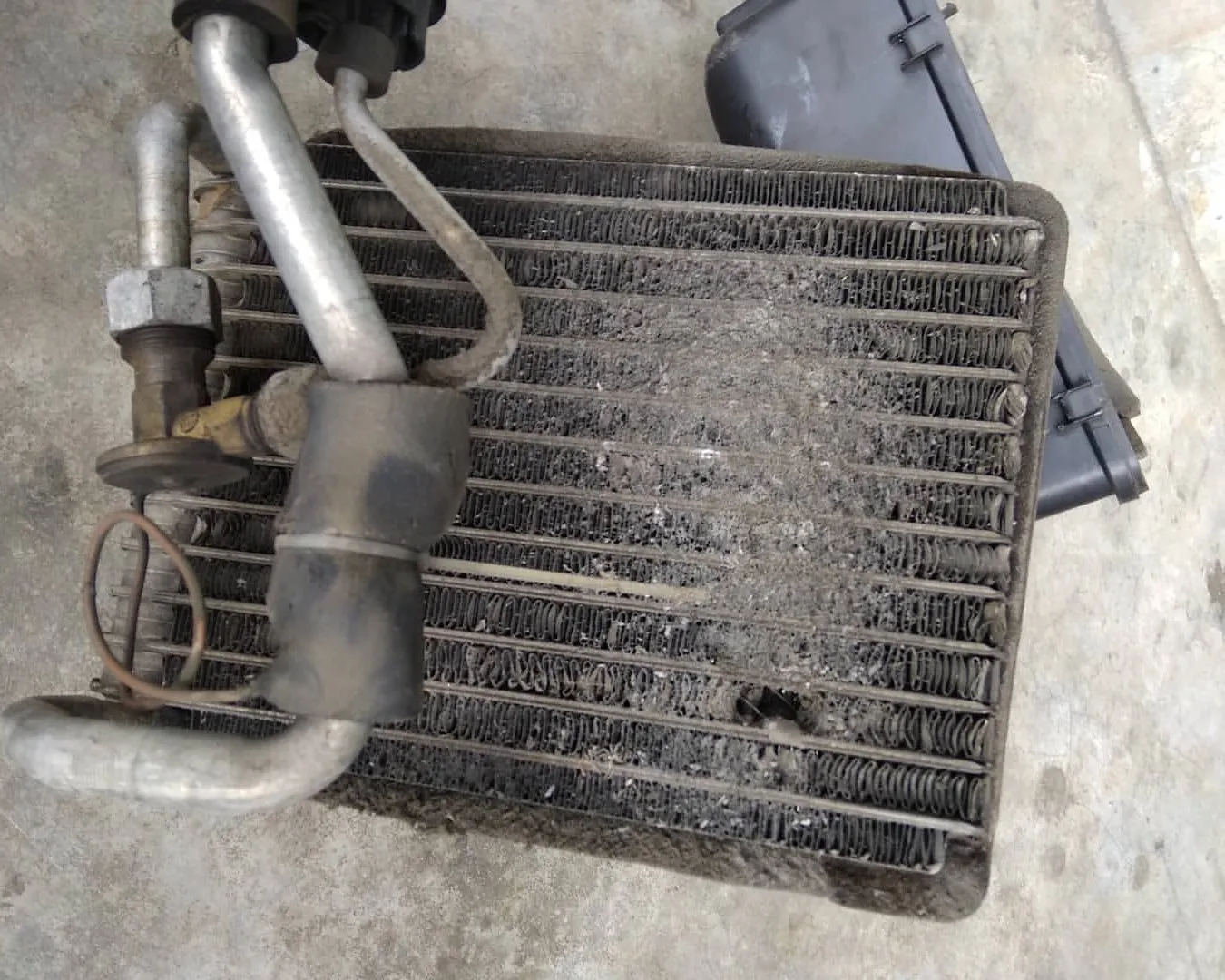
From my experience, this is the most common leak spot. And the one nobody thinks about until it’s too late.
The evaporator lives behind your dashboard. All summer it’s cold and wet. Over the years dust, pollen, little leaves, whatever gets past the filter… it all sticks to it and turns into this slimy gunk.
That gunk keeps moisture sitting on the thin aluminum. Give it enough years and the aluminum corrodes, gets tiny pinholes, and starts leaking.
That’s exactly what happened to one of my cars. Never had the evaporator cleaned. Not once. It finally leaked.
Expansion Valve O-Ring
This one I didn’t see coming.
On another one of my cars, the AC slowly lost its cold. Freon was low again, so obviously a leak. The shop checked the lines. Fine. Checked the evaporator. Also fine.
Turns out the leak was at the expansion valve. One of the O-rings was installed a little twisted, so it never sealed right.
And the timing made sense. That valve had been taken off during my last evaporator service. Somebody rushed putting it back together, and it had been leaking slowly ever since.
That’s the annoying part about AC work. Every time the system gets opened, every fitting that comes apart is a new chance for a leak.
A pinched O-ring won’t show up on the drive home. It shows up weeks later when the air just… slowly isn’t cold anymore.
So after any AC service, do yourself a favor:
- Ask about the warranty before you pay. A 1-month labor guarantee is pretty common. Make sure you know what yours is.
- Keep the invoice. It shows what got disconnected, which tells the next mechanic where to look first.
- Watch it for the first few weeks. Cooling getting weaker? Go back while you’re still covered.
- Ask if they used new O-rings. Some shops reuse the old flattened ones. Not great.
If I’d known this back then, I would’ve caught it inside the warranty window instead of paying twice. Lesson learned.
That Musty Smell? Don’t Ignore It
Before my evaporator died, the car gave me a pretty obvious warning. Every time I turned the AC on, there was this stale, musty smell for the first minute or so. I just kind of… lived with it.
My mechanic later explained what was actually going on, and it changed how I think about AC maintenance.
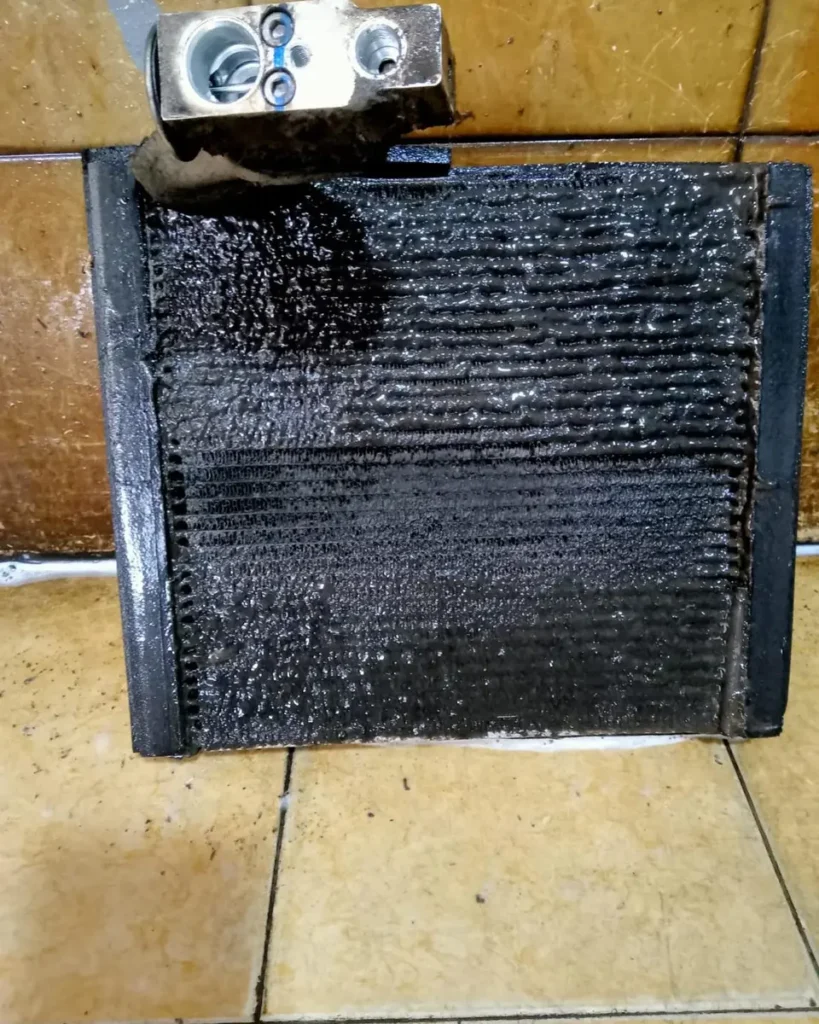
A slimy evaporator doesn’t just stink. The gunk blocks air from flowing through the fins, so the coil gets colder than it should. The evaporator temperature sensor reads that as “about to freeze,” so the system shuts the compressor off to stop ice from forming.
So technically nothing’s broken. The system is protecting itself. But from the driver’s seat it just feels like the AC gave up.
What I do now:
- Change the cabin air filter on time. It’s literally what keeps junk off the evaporator.
- Get the evaporator cleaned every couple of years, especially if the car is parked outside under trees.
- Musty smell = time for service. Not just “eh, it’s an old car.”
Evaporator cleaning is cheap. Replacing one is not. On most cars, the dash has to come out to reach it, and that’s a lot of labor hours.
Compressor Trouble: Listen First
When you hit the AC button, you should hear a soft click from the engine bay. That’s the compressor clutch grabbing.
No click? A loud grind? A squeal? That narrows things down a lot.
I found out the hard way on a Honda Fit, not a CR-V, but same idea. The compressor started making this horrible noise every time it kicked on, it sounded like my grandpa’s tractor diesel. Not long after, it just quit.
What I took away from that: compressors usually die from bad lubrication. The oil travels around the system with the refrigerant.
So a system that’s slowly leaking is also slowly starving the compressor of oil. Fix leaks early. And when the system gets opened up, make sure the shop puts the right amount of oil back in.
Check the Cheap Stuff First
Not every “dead compressor” actually needs a new compressor. Rule these out first:
- AC compressor relay. Hondas are kind of known for this. Relay quits, compressor stops, AC suddenly blows warm. YourMechanic puts the average CR-V job around $107, and the part itself is like $12. Cheapest test in the whole system.
- Thermal protector (3rd-gen CR-V). A 2007 CR-V owner on the Bob Is The Oil Guy forum found a thermal switch was cutting power to the clutch. And it’s a separate part, outside the compressor, so you don’t need to replace the whole thing.
- Worn clutch (2007–2011). Honda actually admitted this one. They put out a bulletin saying the clutch can wear out and make the air not very cold, and extended coverage to 7 years. That window’s closed for pretty much everyone now, but it tells you it’s a real known issue on that generation.
Cold on the Highway, Warm in Traffic
This one fooled me for weeks.
On one of my cars, the AC was totally fine on the open road. But stuck in traffic on a hot afternoon? The vents slowly went lukewarm.
The cause was dumb simple. The condenser was caked with dirt and bugs.
At speed, enough air gets forced through it anyway. At a red light, the fan alone just can’t keep up.
I sprayed it clean with pressurized water, and the cold came right back. Cost me an afternoon. That’s it.
If cleaning doesn’t fix it, check the fan. A failed condenser fan can trip the high-pressure cutoff when you’re sitting still, but the AC still cools fine at highway speed because the car moving pushes air through.
If you clean yours, a couple things:
- Don’t go crazy with the pressure. The fins bend super easily, and bent fins block air just as bad as dirt.
- Engine off. The fans can kick on without warning.
Before You Grab a Recharge Can…
I get it. The cans are cheap and the parts store is right there. But on a CR-V I’d slow down a bit.
Check which refrigerant you have. The CR-V switched to R-1234yf around the 2017 model year. Older ones use R-134a. They’re not interchangeable. And the newer stuff costs almost three times more.
Overfilling is a real problem too. Too much refrigerant can trip the pressure switch, and then the AC cuts out completely. One 2018 owner on TrueDelta said theirs was overcharged from the factory and kept cutting out and blowing warm.
Hybrid owners, skip the DIY cans. The CR-V Hybrid uses an electric compressor, and those need a special insulating oil. Wrong oil or a sealer in there can do real damage. Take it to a shop that knows hybrids.
Sealers are a gamble. Sure, they might plug a tiny pinhole. They can also gum up the expansion valve, and plenty of shops will refuse the job or charge extra once they find sealer in the system.
What It Actually Costs
| Repair | Rough cost |
|---|---|
| Condenser cleaning (DIY) | Basically free |
| AC compressor relay | ~$107 average |
| Condenser replacement (rock damage) | One owner got quoted $1,500+ with Honda parts, ~$1,000 aftermarket |
| Compressor replacement (2015 CR-V) | $870–$1,780 |
| Evaporator replacement | Expensive, mostly labor (dash usually comes out) |
| Expansion valve O-ring | Cheap part, but needs a full evacuate and recharge. Free if it’s still under the shop’s warranty |
| Compressor shaft seal (2017–22 1.5T) | Covered if you’re inside the 10-year extension |
See the gap between the top and bottom of that table? That’s why diagnosing first matters. A $12 relay and a $1,700 compressor can give you the exact same warm air.
My Take After Three Cars
Honestly, most of my AC failures were either preventable or at least kind of predictable.
Dirty condensers and slimy evaporators don’t happen overnight. They build up for years while we ignore the AC… until it quits on the hottest day of the year. Every time.
Stuff I actually do now:
- Clean the condenser every spring
- Change the cabin air filter on time (it’s in the CR-V maintenance schedule)
- Run the AC a few minutes even when it’s cool out, keeps the seals lubricated
- Deal with a musty smell or new compressor noise right away, not “later”
- After any AC repair, confirm the shop’s warranty and keep an eye on it for the first month
- Buying used? Test the AC at idle and at speed. I cover that in my used CR-V buying guide
And if you’ve got a 2017–2022 1.5T that’s started blowing warm, call a Honda dealer with your VIN before you pay anybody anything. One phone call. Could be the difference between a free fix and a four-figure bill.