
CR-V Hybrid Spare Tire Guide: Location, Solution, DIY Tips
You lift the cargo floor of your CR-V Hybrid expecting a donut spare. Instead, you find a small box with a compressor and a bottle of goo.
That’s not a mistake at the factory. It’s how Honda builds every CR-V Hybrid.
Here’s where things actually are, why Honda made that call, and what I’d do about it if this were my car.
Honda CR-V Hybrid Spare Tire Location
There isn’t one. The CR-V Hybrid does not come with a spare tire.
Every hybrid trim (Sport, Sport-L, Sport Touring, and the TrailSport) ships with a Tire Repair Kit (TRK) instead. It lives under the cargo floor panel. Lift the floor board in the cargo area and you’ll find it there.
That kit has two parts:
- A 12V air compressor that plugs into the accessory power outlet
- A bottle of tire sealant that the compressor pushes into the tire through the valve stem
This isn’t new to the current generation. The 2020–2022 CR-V Hybrid also came with only a repair kit. The gas CR-V trims (LX, EX, EX-L) still get a compact spare tire under the floor.
So if you shopped a gas EX-L and a Sport Hybrid side by side, the spare is one of the quiet differences nobody at the dealership mentions. I covered more of those in my Sport Hybrid vs EX-L comparison.
Why the CR-V Hybrid Gets a Repair Kit Instead of a Spare
Honda has never published a one-line answer. But the packaging story is pretty clear once you look at the cargo floor.
The hybrid hardware takes the space
For the 2020–2022 CR-V Hybrid, Honda’s own press kit says it plainly: the Intelligent Power Unit (IPU), meaning the battery pack and its control hardware, “sits below the cargo floor.”
That’s exactly where a spare tire well would go.
The current generation (2023 and newer) has a smaller, lighter IPU. Honda doesn’t publish its exact location, but the cargo floor tells the story.
Gas EX and EX-L models get a two-level cargo floor that drops down to 39.3 cubic feet. Hybrid trims don’t. As Edmunds put it, the hybrids have a floor “permanently fixed at what is effectively the dual-level’s upper floor height.”
Less depth under the floor means no room for a 17- or 18-inch spare.
Weight and efficiency
A compact spare, jack, and wrench add roughly 40–50 pounds. On a car Honda sells on its 40 mpg combined rating, every pound counts.
The Sport Hybrid already weighs about 227 lbs more than a 2WD EX-L. Dropping the spare claws a little bit of that back. You can see the full numbers in my CR-V curb weight by trim breakdown.
Cost
A repair kit is cheaper than a wheel, tire, jack, and wrench. Carmakers rarely say this part out loud, but it’s real.
What the Tire Repair Kit Can (and Can’t) Do
The TRK is fine for one specific kind of flat. Outside of that, it’s useless.
Honda’s own repair kit instructions say do not use the kit if:
- The puncture or cut is larger than 3/16 inch (4 mm), about the size of a pencil eraser
- The sidewall is damaged or the hole is outside the tread contact area
- More than one tire is punctured
- The wheel rim is damaged
- The sealant has expired
After you seal and inflate the tire, Honda says to drive about 10 minutes at no more than 50 mph, then stop and recheck pressure. If it’s dropped below 25 psi, the leak is too severe. Call for a tow.
A screw in the tread? The kit will probably get you home.
A pothole that splits the sidewall on a 19-inch Sport Touring wheel? You’re calling roadside assistance, period.
There’s also the cleanup issue. Some tire shops don’t love patching a tire full of sealant, and you’ll want a new sealant bottle afterward.
The Tire Repair Kit Is Under Recall
This one matters, and a lot of owners don’t know about it yet.
In June 2026, Honda recalled about 1.05 million vehicles over the tire repair kit itself (NHTSA recall 26V-366, Honda code DOV). That covers:
- 2023–2026 Honda CR-V Hybrid
- 2023–2026 Honda Accord Hybrid
- 2025–2026 Honda CR-V e:FCEV
The problem: if the nozzle isn’t connected to the valve properly and the relief valve doesn’t release pressure as designed, pressure builds inside the sealant bottle. The cap can detach. Honda reported eight injuries in the U.S. between September 2022 and May 2026.
Interim owner letters went out July 27, 2026. The fix is a free replacement of the nozzle or sealant bottle at a Honda dealer, with final repair details expected in fall 2026.
If you own a 2023 or newer CR-V Hybrid, run your VIN through NHTSA or call Honda at 866-784-1870. I keep a running list in my CR-V recall history page.
So the only flat-tire tool your hybrid came with is, right now, a recalled part. For me, that alone tips the scale toward a real spare.
Why a Spare Still Matters
If you only drive across town, a repair kit and Honda Roadside Assistance will probably cover you.
But that’s not how a lot of people use this car.
Spend some time in CR-V Hybrid owner groups and you’ll see it fast. People load these things up and drive them across the country. Utah’s national parks. Big Bend. Death Valley. Long, empty highways through Nevada and New Mexico.
That’s exactly where the CR-V Hybrid makes the most sense. 40 mpg and a 14-gallon tank means fewer fuel stops in places where gas stations are 80 miles apart.
It’s also exactly where a repair kit feels thin.
Picture it. You’re on a gravel road in the desert, a sharp rock cuts your sidewall, and your phone says “No Service.” The sealant can’t fix that. The nearest tire shop could be two hours away.
The National Park Service doesn’t sugarcoat it either. Death Valley’s backcountry road page tells visitors to carry “at least one inflated spare tire (preferably two),” and warns that cell reception is “non-existent in most areas of the park.” It also notes that tows are expensive and AAA often won’t cover tows on dirt roads.
That’s not a CR-V Hybrid problem specifically. It’s just reality once you leave the pavement.
In that situation, a real spare isn’t about convenience. It’s peace of mind. You bolt it on, drive to the next town, and your trip continues.
The Real Solution
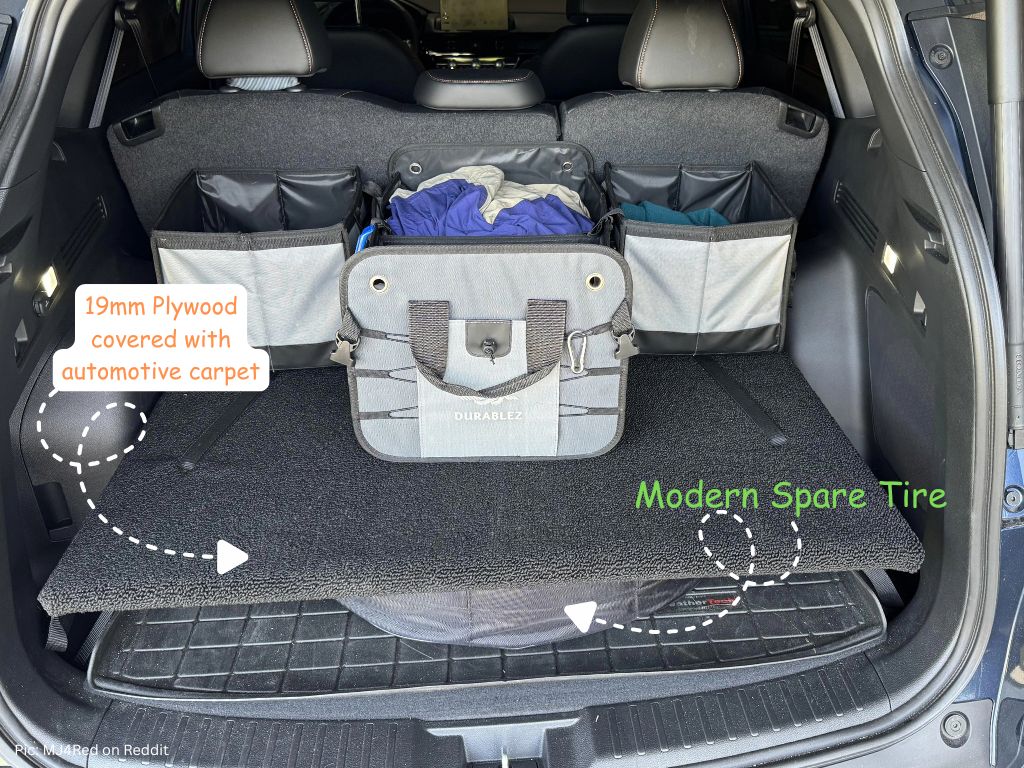
The most popular fix among CR-V Hybrid owners is a model-specific spare kit from Modern Spare, a Utah-based company that builds kits for cars that ship without spares.
Quick disclosure: this isn’t an affiliate link and nobody paid for the mention. It’s just the kit that keeps coming up in owner threads, including one on CR-V Owners Club titled “Modern Spare Tire Already Used for My 2025 Honda CR-V Sport Hybrid.”
What you get
Their 2020–2026 CR-V Hybrid kit lists these specs:
| Component | Spec |
|---|---|
| Wheel | 18×4 aluminum alloy, 5×114.3 mm bolt pattern |
| Tire | T155/90R18, load/speed rating 113M |
| Rolling diameter | 29 inches |
| Jack | TruLift 4,000 lb ratcheting scissor jack |
| Lug wrench | Cross wrench with 17, 19, 21, and 22 mm sockets |
| Extras | Disposable bag for the flat tire, optional nylon carrying case |
Pricing
Kits run $399.95 to $554.95 depending on the option, plus $48 flat-rate shipping in the continental U.S. Options include:
- Wheel & tire only
- Complete kit, with or without carrying case
- Complete Ultra kit with carrying case
- Discounted B-stock complete kit (when available)
If you already have a decent scissor jack and a 19 mm socket, the wheel-and-tire-only option saves money.
Why the 29-inch diameter matters
This is the detail I like most. Compare it to the factory tires:
| CR-V Hybrid trim | Factory tire | Approx. diameter |
|---|---|---|
| Sport / Sport-L | 235/60R18 | 29.1 in |
| Sport Touring | 235/55R19 | 29.2 in |
| Modern Spare | T155/90R18 | 29.0 in |
The spare is within a fraction of an inch of your stock tires.
That matters on an AWD hybrid. A much smaller spare spins faster than the other three tires, and that mismatch isn’t something I’d want to drive on for long with an all-wheel-drive system. A near-matched diameter is the right engineering choice.
The downsides
- No hidden storage. There’s no well to put it in. It rides on top of your cargo floor and eats real space.
- It’s still a temporary spare. The tire is M-rated (up to 81 mph), but Modern Spare’s own instructions note that manufacturers recommend no more than 50 mph on space-saver tires. Treat it like a get-home tire.
- $450–$600 out the door is real money for something you might never use.
- Ship dates can slip. When I checked, the listed ship date was weeks out.
The Cheaper DIY Route: Build Your Own Full-Size Spare
Modern Spare is the easy button. But if you don’t mind a little legwork, you can put together a full-size spare for about a third of the price.
This is the route I’d take.
Step 1: Find a used steel wheel
Check Facebook Marketplace, Craigslist, or a local junkyard. Used steel wheels sometimes go for around $40, especially from people who just sold off a set of winter tires.
If you already have an old wheel sitting in the garage that fits, even better. Now you only need a tire.
What has to match the CR-V:
- Bolt pattern: 5×114.3 mm (also written 5×4.5″)
- Center bore: 64.1 mm, or use a hub-centric ring if it’s larger
- Offset: close to stock, roughly +40 to +50 mm
- Lug nuts: M12×1.5 thread, same as your factory nuts
For the full spec sheet, see my CR-V bolt pattern.
Step 2: Pick the right tire size
This is where most DIY spares go wrong. Your goal is to match the overall diameter of your factory tires, not the wheel size.
A 17-inch wheel is the sweet spot. It’s the cheapest to find, and it’s a popular winter-wheel size for this generation. With the right tire, it lines up almost perfectly:
| Setup | Tire size | Approx. diameter | vs. stock |
|---|---|---|---|
| Stock Sport / Sport-L | 235/60R18 | 29.1 in | — |
| Stock Sport Touring | 235/55R19 | 29.2 in | — |
| 17″ DIY spare (best match) | 235/65R17 | 29.0 in | ~0.1–0.2 in smaller |
| 17″ DIY spare (avoid) | 225/65R17 | 28.5 in | ~0.6 in smaller |
| 18″ DIY spare | 235/60R18 | 29.1 in | exact match |
My pick is 235/65R17. It covers both the 18-inch and 19-inch trims, and it’s one of the most common SUV tire sizes in the U.S., so cheap ones are easy to find.
If your used wheel happens to be an 18, just run the same 235/60R18 your car already wears.
Step 3: Buy a cheap tire
You don’t need a premium tire. It’s a spare. It will sit in the back for years and maybe see 50 miles of use.
A budget-brand new tire, or a used one with healthy tread, is fine. Just check two things:
- The load index should match or beat your factory tires (it’s printed on the sidewall).
- The DOT date code shouldn’t be ancient. Rubber ages even when it’s not used.
Step 4: Get a jack and lug wrench
A scissor car jack kit on Amazon costs about $30 and usually includes a lug wrench. Make sure the wrench fits 19 mm lug nuts, which is what Honda uses.
What it costs
| Item | Approx. cost |
|---|---|
| Used 17″ steel wheel | ~$40 |
| Budget 235/65R17 tire + mounting | ~$90–$140 |
| Scissor jack kit with lug wrench | ~$30 |
| Total | ~$160–$210 |
Compared with $450–$600 for a Modern Spare kit shipped, that’s a big saving.
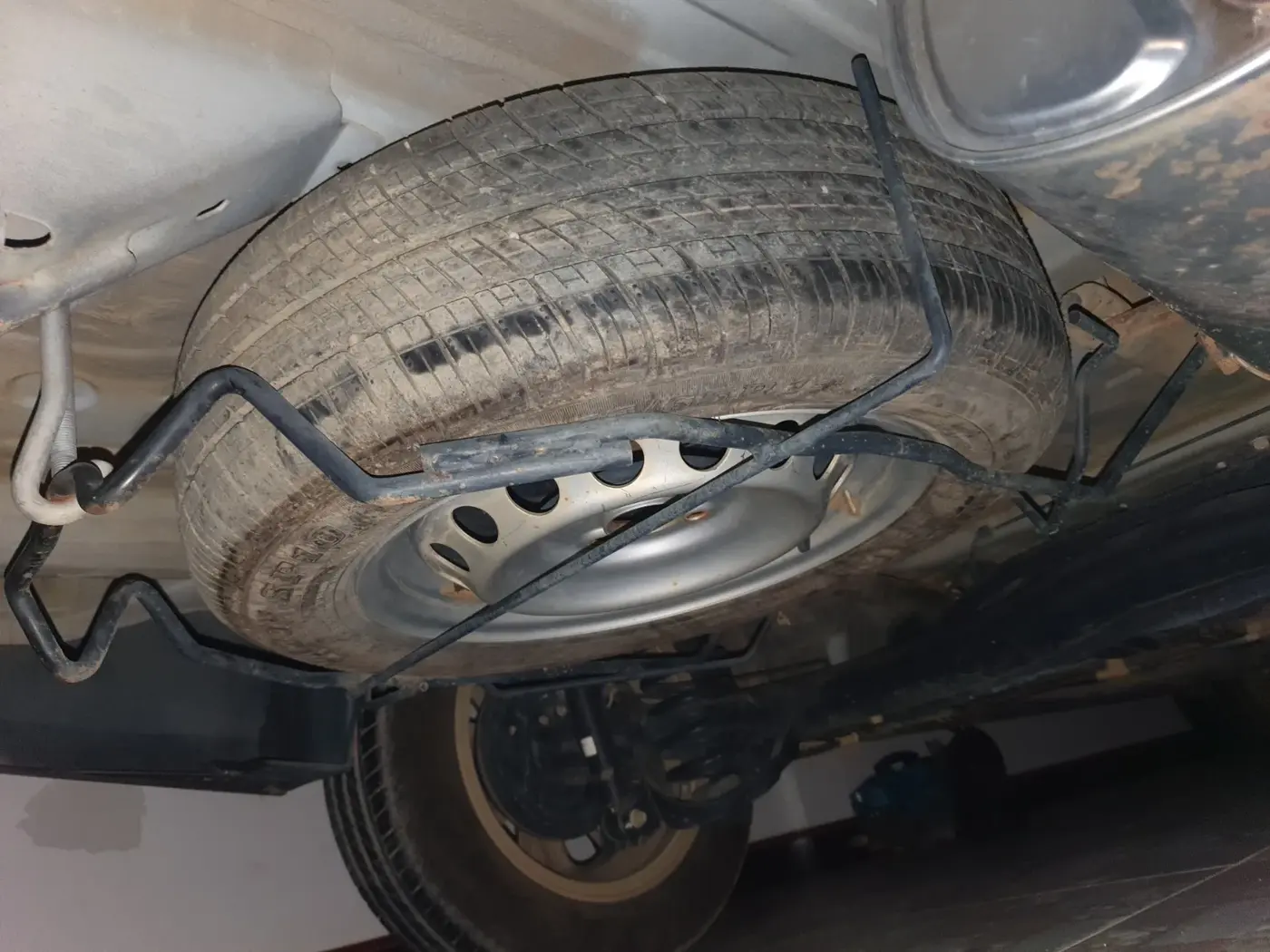
You also get something better on paper: a full-size tire, not a compact. No 50 mph limit. If you’re 150 miles from the nearest tire shop, you can just keep driving at normal highway speed.
The trade-offs
- It’s bulky. A full-size 235-width tire is a lot fatter than a compact spare. It will take a real chunk of your cargo area.
- It’s heavy. Expect roughly 50 lbs for a steel wheel and tire.
- Test-fit it first. Bolt it onto a front hub at home before your trip. Steel wheels have a different inner profile than alloys, so confirm it clears the brake caliper and spins freely.
- AWD caution. If your other three tires are badly worn, a brand-new spare won’t match them perfectly. For a get-home situation it’s fine. Don’t leave it on for weeks.
That’s the price of saving a few hundred dollars. For a lot of road-trippers, it’s an easy trade.
Other Options Worth Knowing
- A plug kit + portable compressor ($30–$70). Rope plugs fix more punctures than sealant does and don’t gunk up the tire. Still useless for sidewall damage. I’d carry one even with a spare.
- Roadside assistance only. New Hondas come with 24/7 roadside assistance for 3 years/36,000 miles. If you mostly drive in town with good cell coverage, this might be enough.
If you road-trip through national parks, desert highways, or anywhere with long stretches of no signal, I’d carry a real spare. If you commute 15 miles in the suburbs, a plug kit and a good compressor cover most of the risk.
Carrying and Using a Spare in Your CR-V Hybrid
Storing it
- Wrap it first. A tire tote bag or spare tire cover costs about $15–$25 and keeps brake dust and road grime off your luggage. Modern Spare’s carrying case does the same job.
- Lay the spare flat against the back of the rear seats, not loose in the middle of the cargo area.
- Strap it down using the cargo tie-down hooks. A 30- to 50-pound wheel turns into a projectile in a hard stop.
- On a road trip, pack the spare first and load the bags around it. You don’t want to unload everything on the shoulder to reach it.
- On the Sport Touring, cargo space is already lower (34.7 cu ft) because of the subwoofer behind the right side panel. Plan the layout before you commit.
Changing the tire
- Park on flat, solid ground. Set the parking brake and turn on the hazards.
- Loosen the lug nuts a half turn before you jack the car up. Honda uses 19 mm lug nuts.
- Use the designated jack points on the pinch welds behind the front wheels and in front of the rear wheels. The owner’s manual shows the exact spots.
- Never put any part of your body under a car on a scissor jack.
- Tighten in a star pattern. Honda’s wheel nut torque for the CR-V is 80 lb-ft. Modern Spare’s generic instructions quote 100–140 lb-ft, so go with your owner’s manual for your specific car.
After you put it on
- The Modern Spare ships at 60 psi. A DIY full-size spare should be set to the pressure on your driver’s door jamb sticker. Check either one every few months, and always before a long trip.
- Your tire pressure warning light may come on with the spare installed. After the repaired tire goes back on, run the TPMS calibration through the vehicle settings menu.
- Get the flat repaired or replaced quickly. A spare is a bridge, not a wheel you live on.
My Take
If I were buying a used CR-V Hybrid tomorrow, a spare would go on my shopping list right after a pre-purchase inspection.
Not because flats happen often. They don’t. But when one does, the tool Honda gave you can’t handle a sidewall cut, and right now it’s under recall.
If you want it done in one click, Modern Spare is the clean, well-engineered option. If you’d rather spend $200 and an afternoon scrolling Marketplace, the DIY full-size spare gets you something even more road-trip-ready.
Check that recall status first. Then think about the emptiest road you plan to drive this year, and pack for that one.