
Complete Honda CR-V Recall Guide (2023–2026)
I went through every NHTSA filing tied to the CR-V from the 2023 through 2026 model years. Thirteen separate campaigns, and the hybrid carries most of the weight.
That’s not a coincidence. Every hybrid-specific defect on this list — the battery cable, the e-CVT, the fuel hose, the tire kit — doesn’t exist on the gas trims.
If you’re cross-shopping LX against Sport Hybrid, this list alone tells you something about complexity trade-offs.
| Model Year Issued | Recalls | Main Issues |
|---|---|---|
| 2023 | 4 | Seat back frame weld, e-CVT resolver (Hybrid), 12V battery cable fuse (Hybrid), fuel pump |
| 2024 | 5 | Seat weight sensor (phase 1), tire label date code, steering gearbox, HV battery terminal (Hybrid), high-pressure fuel pump (Hybrid) |
| 2025 | 2 | Fuel feed hose (Hybrid), fuel cell stack (Fuel Cell EV) |
| 2026 | 2 | Seat weight sensor (expanded), tire repair kit sealant bottle (Hybrid/Fuel Cell EV) |
2023: four recalls, one genuinely serious
23V-092 — front passenger seat back frame (Feb 2023).
Some 2023 CR-Vs left the factory with a poorly welded seat back frame. In a crash, that seat could fail to hold the occupant in place. Honda’s code is 6PK. Dealers replace the entire seat back frame assembly.
23V-588 — e-CVT resolver issue, hybrid only (Aug 2023).
This one’s mechanical, not electrical-fire scary, but still annoying. The resolver cover on the generator motor can get damaged during manufacturing, which lets it cut into the wire harness.
End result: check engine light, the car limps into EV-only mode with limited range, or in worse cases won’t restart. Codes NFG and HFF. Remedy is a full e-CVT replacement — not a small job.
23V-844 — 12V battery cable, no fuse (Dec 2023).
This is the big one from 2023. It hits 2020–2022 CR-V Hybrids, about 106,000 of them, for a positive battery cable that was built without a fuse. Crash the left front corner hard enough and that cable can short and overheat — fire risk. Honda’s code is FGB, and the fix adds a 100-amp fuse to the cable assembly.
23V-858 — fuel pump failure (Dec 2023).
A sprawling multi-model recall covering 2013–2023 Accord, Civic, CR-V, HR-V, and a batch of Acuras, plus 2020 CR-V Hybrids specifically. The in-tank fuel pump can fail and stall the engine while you’re driving. Codes KGC and KGD.
I’d flag two more from this window that technically apply to older model years (a 2017/2020/2022 door label mix-up, and a 2017–2020 seat belt buckle issue) — they’re not core 2023–2026 MY problems, so I’m leaving them out of the count here, but worth a footnote if you go deeper on any single CR-V generation.
2024: the steering recall that made headlines
24V-064 — seat weight sensor, phase one (Jan 2024).
2020–2021 CR-V and CR-V Hybrid, among a long list of other Honda and Acura models. The front passenger seat weight sensor can crack and short, which means the airbag might not suppress correctly — or might deploy when it shouldn’t. Codes XHP and VHQ. This recall got mailed in three separate waves: March 2024, October 2024, and again in August 2025.
24V-508 — tire label defect (Jul 2024).
Narrow one: 2024 CR-Vs where the tire identification number is missing its date code. Not dangerous on its own, but it means you can’t tell if your tires are subject to a separate tire recall. Code BIS.
24V-744 — steering gearbox, the big one (Oct 2024).
If you’ve seen “Honda sticky steering recall” in a headline, this is it. Over 1.6 million vehicles across CR-V, CR-V Hybrid, HR-V, Civic, and several Acura models — the steering gearbox worm gear was manufactured with excess internal friction, so the wheel gets hard to turn, especially after sustained highway speeds.
NHTSA opened an engineering analysis on this back in November 2023 after complaints about “sticky steering,” and it eventually linked to 13 crashes before the recall dropped.
Codes SJS, MJU, QJT, VJV. I found owner threads on forums describing the steering wheel shaking intermittently even after the recall repair —a nuance worth noting if you’re tracking real-world owner experiences, not just official service bulletins.”
24V-745 — HV battery terminal, hybrid only (Nov 2024).
Tiny population — just 98 units — but worth knowing about. Some 2023 CR-V Hybrid high-voltage battery modules had a terminal or busbar that could break and spark. Code HJR, remedy is a full battery module replacement.
2025: fuel system problems on the hybrid
24V-763 — high-pressure fuel pump (letters mailed Feb 2025).
Covers 2023–2024 Accord and Accord Hybrid, 2023–2025 CR-V Hybrid, and 2025 Civic/Civic Hybrid. The high-pressure pump can crack and leak fuel — 720,810 vehicles total. Code PJW.
25V-378 – fuel feed hose, hybrid only.
2025 CR-V Hybrids where the fuel feed hose wasn’t installed correctly, which can let fuel leak out. Dealers install a new hose and connector cover.
25V-858 — fuel cell stack (letters Feb 2026).
Small but specific: 2025 CR-V Fuel Cell EV, 388 units, an issue with the fuel cell stack assembly itself. Code CN4.
2026: the airbag sensor expands, and a 1-million-unit tire kit recall
26V-332 — seat weight sensor, expanded (May 2026).
This is Honda widening the net on the 24V-064 airbag sensor issue — now pulling in 2020–2022 CR-V Hybrid and 2017–2022 gas CR-V, on top of the long list of other affected models.
Same failure mode: cracked sensor, unintended airbag behavior. A long list of Honda codes here, since it folds in so many production runs.
DOV — tire repair kit, over a million units (announced June 2026).
This is the newest and, by unit count, the biggest recall on the list: 1,049,883 vehicles, split across 2023–2026 CR-V Hybrid (744,530 of them), 2023–2026 Accord Hybrid, and 2025–2026 CR-V Fuel Cell EV.
The tire repair kit — remember, hybrids don’t get a spare, just this kit — can build dangerous pressure in the sealant bottle if the nozzle isn’t seated correctly on the valve.
The cap can pop off under pressure. Honda logged 53 warranty claims and 8 injuries before issuing the recall, with the first report going back to April 2023.
Dealers are replacing the nozzle and sealant bottle; interim letters went out July 27, 2026, with the final parts expected fall 2026.
How to check if your CR-V is affected
You don’t need to memorize any of the campaign numbers above. Honda’s own VIN lookup tool will tell you in seconds.
- Go to mygarage.honda.com/s/recall-search.
- Enter your CR-V’s 17-digit VIN — it’s on the driver-side dashboard where it meets the windshield, or on your insurance card.
- Hit search. The tool pulls every open recall tied to that specific VIN, not just your model year in general.
- Each result shows the recall name and its status — open, or already completed by a dealer.
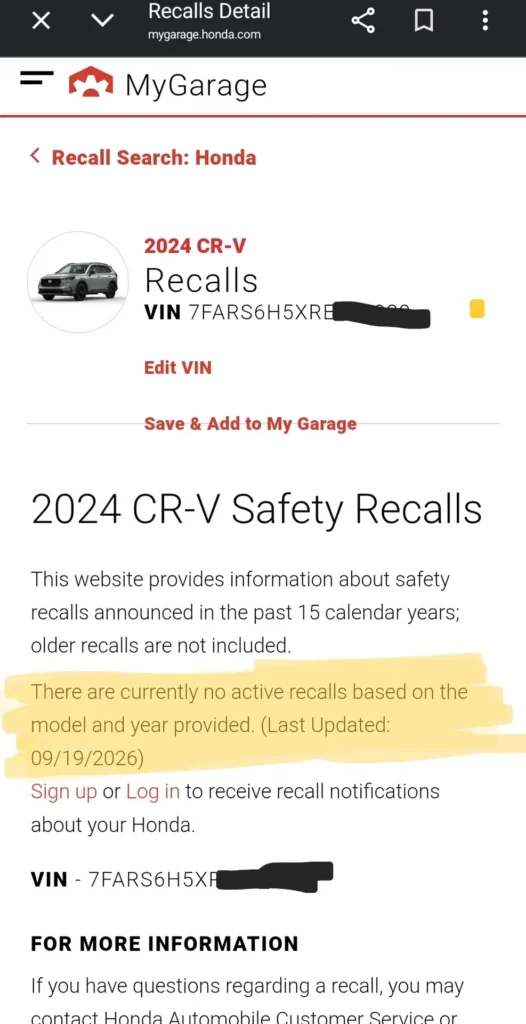
Two things worth knowing before you rely on this alone.
First, a “completed” status means Honda’s records show a dealer closed it out — it doesn’t confirm the repair actually solved the problem, which matters for that steering gearbox recall I mentioned above.
Second, if you want a second source, NHTSA.gov runs its own VIN lookup pulling from the same federal database, and it’s worth cross-checking if the Honda tool ever looks slow to update.
What this actually means if you’re buying used
Here’s my actual take, and it’s not subtle: if you’re looking at a 2023–2025 CR-V Hybrid specifically, don’t just glance at the VIN recall lookup and call it done.
Check that the steering gearbox recall (24V-744) was completed, not just scheduled — I’ve seen enough forum posts about lingering steering shake after the “fix” to not fully trust a checkbox on a service record.
A clean VIN check only tells you Honda’s paperwork is done. It doesn’t tell you the dealer did the work right, or that nothing else on the car needs attention. Get your hands on it — pop the hood, check under the car, take it for a real test drive — before you sign anything. I go through exactly what to look for in my used CR-V buying guide.
And if the tire repair kit recall (DOV) hasn’t been done yet on the car you’re looking at, don’t touch that kit if you get a flat before the dealer visit. Call Honda Roadside Assistance instead.
Gas CR-V buyers have it easier here — your list is really just the seat back weld (2023), the tire label glitch (2024), and your share of the steering gearbox and seat sensor recalls. Nothing hybrid-exclusive to chase down.