
2026 CR-V Sport Hybrid vs EX-L: Premium vs Efficiency!
Here’s the number that changes everything: EX-L runs $35,800, Sport Hybrid runs $36,030. That’s a $230 gap.
A couple of years ago, picking between a gas CR-V and a hybrid one meant doing math. You’d weigh a $2,000-$3,000 hybrid premium against your annual mileage and decide if the fuel savings ever caught up. That math just isn’t relevant to this particular matchup — not when the two trims sitting across from each other are $230 apart.
If you want the fully-loaded hybrid experience — leather, the bigger cluster, the works — that trade-off still exists, it’s just one trim higher. Sport-L Hybrid is where Honda puts leather seats and the 10.2-inch cluster back on a hybrid drivetrain. This comparison is specifically about EX-L and Sport Hybrid, where that option isn’t on the table.
When the price difference is smaller than a set of all-season tires, the powertrain debate is over before it starts. Nobody in their right mind pays roughly the same money for 190 hp and 30 mpg when 204 hp and 40 mpg sit right next to it on the price sheet.
So that’s not what this comparison is about. This is about what you’re actually buying for that $35-36K, because EX-L and Sport Hybrid split Honda’s lineup into two very different priorities — and neither one is obviously “better.”
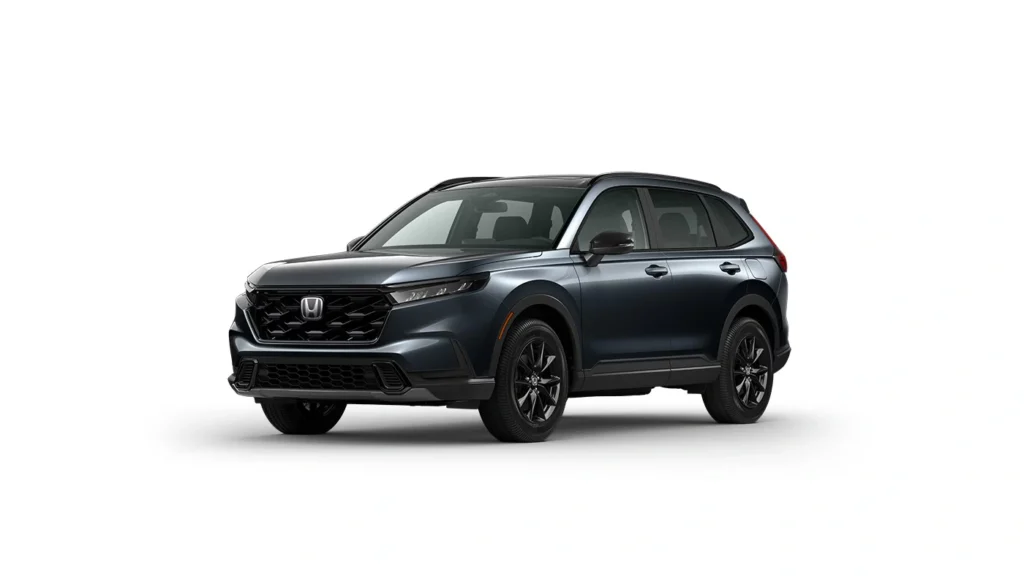 CR-V Sport Hybrid
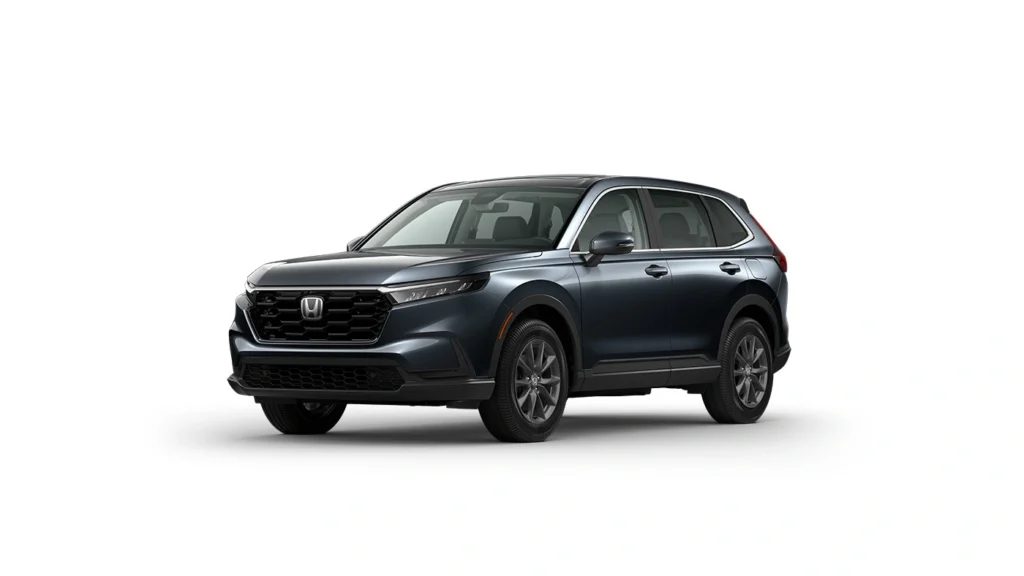 CR-V EX-L
The Real Fork in the Road
EX-L is the top trim of the gas lineup. It’s the “give me every comfort feature Honda makes on a 1.5T” pick.
Sport Hybrid is the entry point into the hybrid lineup. It’s the “give me the efficient powertrain, I’ll live without some extras” pick.
That’s the actual trade-off. Not gas vs. hybrid — comfort-loaded vs. efficiency-first.
Price & Powertrain at a Glance
| EX-L (Gas) | Sport Hybrid | |
|---|---|---|
| MSRP | $35,800 | $36,030 |
| Engine | 1.5L turbo I-4 | 2.0L Atkinson I-4 + two-motor hybrid |
| Horsepower | 190 hp @ 6,000 rpm | 204 hp total system |
| Transmission | CVT | Direct Drive Unit (e-CVT style) |
| MPG (2WD, city/hwy/combined) | 28 / 33 / 30 | 43 / 36 / 40 |
| MPG (AWD, city/hwy/combined) | 27 / 31 / 29 | 40 / 34 / 37 |
| Towing capacity | 1,500 lbs | 1,000 lbs |
| Curb weight (2WD) | 3,525 lbs | 3,752 lbs |
The hybrid drivetrain adds roughly 227 lbs to the curb weight on paper — that’s the battery pack and second motor, and you feel it a little in the way the Sport Hybrid settles into corners versus how eager the lighter gas EX-L feels off the line despite having less horsepower.
Ten extra mpg combined is not a small number if you’re putting 15,000 miles a year on this thing. Over five years that’s real money back in your pocket, hybrid premium or not.
Where EX-L Pulls Ahead
This is the trim Honda built for people cross-shopping a compact SUV against something with a nicer interior. Here’s what EX-L gets that Sport Hybrid doesn’t:
- 10.2-inch Digital Instrument Cluster — Sport Hybrid is stuck with the smaller 7-inch TFT meter display
- 320-Watt, 8-speaker audio system — versus Sport Hybrid’s 240-Watt, 6-speaker setup
- Leather-trimmed seats — Sport Hybrid gets cloth; leather doesn’t show up again until you jump to Sport-L
- Two-position driver’s seat memory
- 4-way power passenger seat adjustment — Sport Hybrid’s front passenger only gets manual height adjustment
- Automatic-dimming rearview mirror
- Parking sensors, 4 front and 4 rear
- Low Speed Braking Control
- Power tailgate
- Acoustic laminate windshield — genuinely reduces road and wind noise, worth mentioning since cabin quiet is one of the CR-V’s better traits
- All-windows auto up/down — Sport Hybrid only gets driver and front passenger auto windows
That’s not a minor features gap. That’s most of what people mean when they say a car “feels premium” inside.
Where Sport Hybrid Gets Trimmed
Sport Hybrid is Honda’s entry-level hybrid, and it shows. Compared to EX-L, you lose:
- The bigger digital cluster (7-inch TFT instead)
- Two full speakers and 80 watts of audio power
- Leather seating surfaces
- Automatic-dimming mirror, parking sensors, power tailgate — all gone
- The dual-level cargo floor (more on this below)
What Sport Hybrid keeps or adds instead: Honda Sensing across the board, wireless Apple CarPlay/Android Auto, wireless Qi charging, black roof rails, gloss black mirror caps, dual chrome exhaust finishers, and Active Sound Control for the drivetrain. It also looks noticeably sportier — 18-inch Berlina Black wheels versus EX-L’s Shark Gray, plus the exterior black trim accents EX-L doesn’t get.
So it’s not that Sport Hybrid is a stripped-out econobox. It’s that Honda drew a clear line between “efficient and sporty-looking” and “loaded with comfort tech,” and made you choose.
The Cargo Space Catch Nobody Mentions
This is the part that actually matters if you haul stuff regularly, and it’s the detail most spec sheets bury.
EX-L: 39.3 cu ft behind the second row. Sport Hybrid: 36.3 cu ft behind the second row.
That’s not a rounding difference — it comes down to the cargo floor design itself. Gas EX/EX-L trims get a dual-level floor, similar to what you’ll find in a RAV4 or Tucson, which lets you drop the floor down for extra depth.
Hybrid trims use a floor that’s permanently fixed at what would be the upper level on the gas cars, because the battery pack and hybrid hardware live underneath.
Owners who’ve actually loaded these up for cargo tests have noted the hybrid’s floor doesn’t lift out the way you’d expect — there’s no grab handle, because it’s not meant to come off. It’s a fixed panel sitting over the hardware, not a removable false floor.
Hybrid trims also skip the spare tire entirely in favor of a tire repair kit. If you’ve ever actually needed a spare on the side of the highway, that’s worth factoring in before you buy — a repair kit doesn’t help you with a sidewall puncture or a shredded tire.
What They Actually Share
With everything above, it’s easy to walk away thinking these two are worlds apart.
They’re not — Honda’s been generous with standard equipment across the whole 2027 lineup, and EX-L and Sport Hybrid overlap on more than you’d expect.
Worth knowing before you assume you’re “settling” either way:
- Full Honda Sensing suite — CMBS, Adaptive Cruise Control, Lane Keeping Assist, Road Departure Mitigation, Forward Collision Warning, Traffic Sign Recognition, Blind Spot Information, rear cross-traffic monitor, and Traffic Jam Assist, standard on both
- 9-inch touchscreen with wireless Apple CarPlay and Android Auto
- Wireless Qi charging pad
- HondaLink, including subscription services
- Dual zone climate control and heated front seats
- Leather-wrapped steering wheel and shift knob — leather on the wheel even though Sport Hybrid’s seats are cloth
- One-touch power moonroof
- Ambient LED lighting (white) and illuminated sunvisor vanity
- Active Noise Cancellation
- LED headlights, taillights, and daytime running lights
- Heated side mirrors and Smart Entry with Walk Away Auto Lock
- Privacy glass
- FWD standard, AWD available — neither trim forces you into all-wheel drive; it’s an option on both
That’s a genuinely long list of features Honda didn’t gatekeep behind a higher trim.
Whichever one you pick, you’re not driving a “base model” experience — you’re getting the same safety tech, the same core convenience features, and a comparably equipped cabin at the fundamentals.
The differences we covered above are real, but they’re refinements on top of a shared foundation, not a gap between a loaded car and a stripped one.
My Actual Take
I’ve spent enough time under CR-Vs of every generation to have an opinion here, and it’s this: at a $230 price gap, I’d take the Sport Hybrid for anyone doing real miles — commuters, road-trippers, anyone who cares what they spend at the pump every month.
Ten mpg combined isn’t a rounding error, and 204 hp with instant torque from the electric motor makes the Sport Hybrid feel quicker in daily driving than its 145 hp gas-engine number on the spec sheet suggests.
Here’s the thing though — I’m not even a commuter, and I’d still lean hybrid. At a $200-ish gap, the math just tilts too far in the hybrid’s favor to ignore, mileage habits aside. It’s less about how far I drive and more about not wanting to leave that kind of efficiency on the table for basically the same money.
The feature cuts do sting a bit, and if I’m honest, the leather seats are the one I’d miss most. Cloth on a nearly-$36K SUV feels like the trim’s one obvious weak spot.
But that’s also the easiest one to fix yourself down the road — I had aftermarket leather covers installed on a Honda Fit once and walked away genuinely happy with how it turned out.
Do that a year or two in, and the fuel savings from the hybrid drivetrain start paying for that upgrade on their own.
I still wouldn’t pretend the EX-L’s feature set doesn’t matter. If you spend real time in the cabin — long commutes, road trips with the family — the leather seats, better cluster, parking sensors, and power tailgate add up to a noticeably nicer place to sit.
Those aren’t gimmicks. They’re the things you touch and notice every single day, unlike an instrument cluster spec you’ll forget about after the first week.
The honest answer depends on what you actually do with the vehicle, not on chasing the “smarter” powertrain on paper.
But given how close the price sits, my own money would go toward the hybrid — and I’d budget for seat covers later.
Which One Should You Actually Buy?
Go EX-L if: you want the nicest cabin Honda offers on the standard CR-V, you don’t drive enough miles for the fuel savings to matter much, or you tow more than 1,000 lbs regularly.
Go Sport Hybrid if: fuel economy actually affects your monthly budget, you like the sportier black-trim look, or you’re fine trading some cargo depth and seat leather for a drivetrain that’ll cost less to run for the next decade.
Either way, at this price gap, you’re not paying a premium for efficiency anymore — you’re paying a premium for leather and a bigger screen. Know which one you’re actually shopping for before you sit down with a sales manager.