
Honda CR-V Turning Radius: Specs & Real-World Impact
If you’ve ever squeezed a CR-V into a tight parking garage or tried to do a U-turn on a narrow street, you already have an opinion on this.
But if you’re shopping for one and want the actual numbers — here they are, straight from Honda’s official press specs.
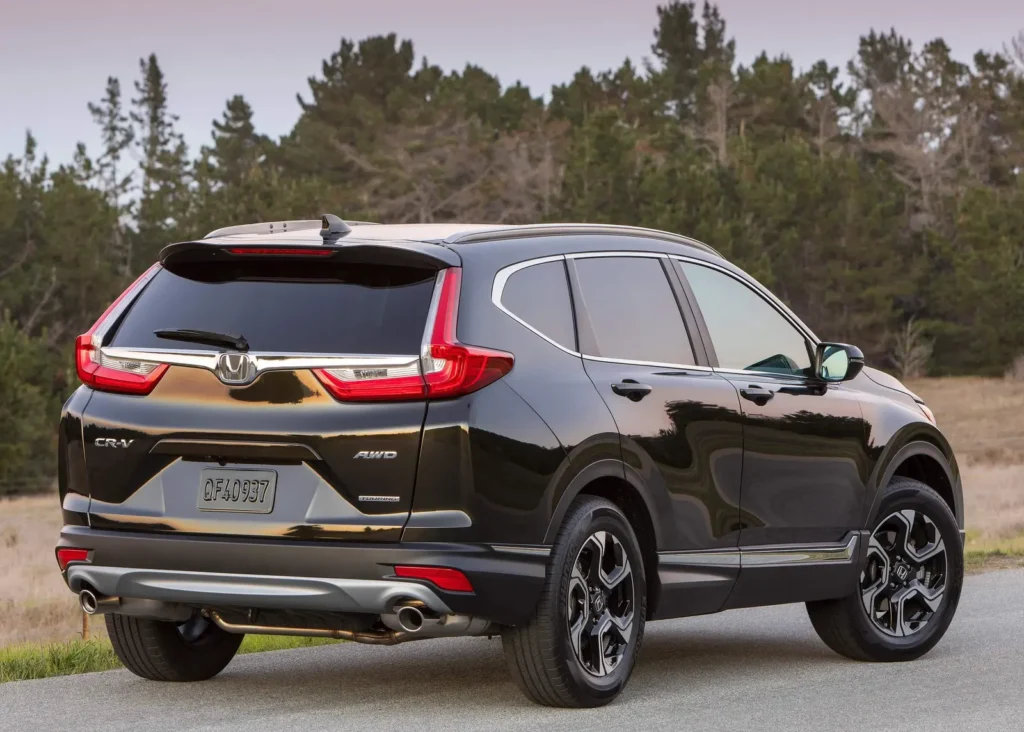
The 2026 CR-V Numbers First
There’s actually a difference between gas and hybrid trims that most people don’t know about:
| Powertrain | Turning Diameter (curb to curb) |
|---|---|
| Gas — LX, EX, EX-L | 37.3 ft |
| Hybrid — Sport, TrailSport, Sport-L, Sport Touring | 37.0 ft |
Both use the same dual-pinion electric power steering and 2.4 turns lock-to-lock. The 0.3 ft gap comes from differences in front suspension geometry between the two platforms — subtle, but it’s real and confirmed by Honda.
All Generations, All the Data
Here’s what most sites don’t show you — the full historical picture. And there’s a surprising pattern in here.
| Generation | Years | Turning Diameter | Steering Ratio | Lock-to-Lock |
|---|---|---|---|---|
| Gen 1 | 1997–2001 | 34.8 ft | 17.1 | 3.23 turns |
| Gen 2 | 2002–2006 | 33.8 ft | 16.3 | 3.26 turns |
| Gen 3 | 2007–2011 | 37.8 ft | 15.74 | 2.96 turns |
| Gen 4 | 2012–2016 | 37.5 ft (2WD) / 36.9 ft (AWD) | 15.59 | 2.94 turns |
| Gen 5 | 2017–2022 | 37.4 ft | 12.3 | 2.3 turns |
| Gen 6 | 2023–2025 | 37.3 ft | 12.4 / 12.3 (AWD) | 2.4 turns |
| Gen 6 | 2026 | 37.3 ft (gas) / 37.0 ft (hybrid) | 12.4 / 12.3 (AWD) | 2.4 turns |
Source: Honda official press specifications, all generations.
The old CR-Vs were actually more nimble. The 2003 CR-V turned in a 33.8 ft circle — tighter than anything Honda makes today.
When Honda moved to the Gen 3 platform in 2007, the turning circle jumped nearly 4 feet wider overnight.
The bigger wheelbase and wider body demanded it. Honda has been slowly chipping away at that number ever since, but 20 years later, still hasn’t gotten back to where the Gen 2 was.
In 2012–2016, the AWD model (36.9 ft) actually turned tighter than the 2WD (37.5 ft). That’s counterintuitive — AWD usually adds mechanical bulk that hurts agility.
Honda achieved this through different front suspension geometry on the AWD variant. It quietly disappeared as a distinction in Gen 5, when the whole platform was rethought.
The steering ratio going from 15.59 to 12.3 between Gen 4 and Gen 5 is the biggest single steering change in CR-V history.
A quicker ratio means less wheel movement needed for the same turn. This is the main reason Gen 5 owners consistently describe the car as feeling noticeably sharper and more car-like compared to previous generations.
How It Compares to Competitors
| Vehicle | Turning Diameter |
|---|---|
| 2026 Honda CR-V Hybrid | 37.0 ft |
| 2026 Honda CR-V Gas | 37.3 ft |
| 2026 Toyota RAV4 | 37.7 ft |
| 2026 Nissan Rogue | 37.7 ft |
| 2026 Hyundai Tucson | 37.7 ft |
| 2026 Ford Escape | 36.7 ft |
| 2026 Chevrolet Equinox | 38.1 ft |
The CR-V Hybrid is second only to the Escape in this group. The RAV4, Rogue, and Tucson all sit at 37.7 ft — half a foot wider than the CR-V Hybrid. Not dramatic on paper, but you feel it in tight parking lots.
What These Numbers Feel Like in Real Life
I also own a Ford Ranger Single Cab — a great truck in many ways, but its turning radius is a nightmare in the city. There was one time I completely misjudged a turn at a busy intersection, ended up blocking traffic, and had to do an embarrassing multi-point maneuver while everyone waited. That’s what a wide turning circle actually costs you in the real world.
It’s one of the reasons I really appreciate how the CR-V handles tight situations. The difference between 37 ft and 45+ ft of turning diameter sounds small on paper, but behind the wheel it feels like an entirely different vehicle.
Standard parking lots — no problem. The CR-V fits comfortably into typical 90-degree stalls and can navigate most lot layouts without needing a three-point correction.
U-turns — the honest answer is that on a standard two-lane road (roughly 24 ft wide), you probably need the curb or a slight correction. At ~18.5 ft turning radius, a single-motion U-turn in that space is tight. This is true for virtually every compact SUV — the CR-V isn’t unusual here, just realistic.
Multi-story garages — fine. US parking structures are typically designed for vehicles needing up to 23–26 ft turning radius on ramps. The CR-V clears this comfortably.
Parallel parking — manageable, especially with the backup camera and sensors. The car responds predictably during the cut-and-correction sequence. A space of about 22 feet (roughly 120% of the CR-V’s length) is the practical sweet spot.
One thing that consistently comes up in owner forums: the CR-V feels more maneuverable than its numbers suggest. A lot of that comes down to the dual-pinion EPS giving consistent, low-effort steering at low speeds, combined with reasonably good sightlines out of the greenhouse. You can actually see the front corners of the car when you need to, which matters more than people realize.
Does Trim or Tire Size Affect Turning?
Not meaningfully for day-to-day driving. The 2026 CR-V runs three wheel sizes across trims — 17-inch on the LX, 18-inch on most other trims, and 19-inch on the Sport Touring. Honda’s official turning diameter figures already account for each trim’s equipped tires.
The TrailSport uses all-terrain tires on 18-inch wheels but shares the same 37.0 ft turning diameter as other hybrid trims.
Parking Aids by Trim
The turning radius is only half the picture. What Honda puts around it matters too:
- Rearview camera with dynamic guidelines — standard on all 2026 trims
- Front and rear parking sensors — standard from EX-L / Sport-L upward
- Low Speed Braking Control — standard from EX-L / Sport-L upward; applies automatic braking if you’re about to hit something at very low speed
The rearview camera on the CR-V is one of the better implementations in the class — clear image, accurate guidelines, useful placement. It’s one of those things you notice when renting a competitor and coming back.
Frequently Asked Questions
Final WOrds
Turning radius isn’t just a number—it can be an indicator of whether a car is easy to drive or not.
And the Honda CR-V has a pretty stellar reputation as an SUV that’s very easy to drive; its turning radius is excellent, making it easy to park or maneuver on relatively narrow and crowded city streets.
If you have any further questions, feel free to leave a comment below!
All turning diameter data sourced from Honda official Honda press specifications. Competitor data from respective manufacturer press specifications.